
The premature death of that celebrated young monarch, Edward VI, occasioned the most extraordinary and wonderful occurrences, which had ever existed from the times of our blessed Lord and Savior's incarnation in human shape. This melancholy event became speedily a subject of general regret. The succession to the British throne was soon made a matter of contention; and the scenes which ensued were a demonstration of the serious affliction in which the kingdom was involved. As his loss to the nation was more and more unfolded, the remembrance of his government was more and more the basis of grateful recollection. The very awful prospect, which was soon presented to the friends of Edward's administration, under the direction of his counsellors and servants, was a contemplation which the reflecting mind was compelled to regard with most alarming apprehensions. The rapid approaches which were made towards a total reversion of the proceedings of the young king's reign, denoted the advances which were thereby represented to an entire resolution in the management of public affairs both in Church and state.
Alarmed for the condition in which the kingdom was likely to be involved by the king's death, an endeavor to prevent the consequences, which were but too plainly foreseen, was productive of the most serious and fatal effects. The king, in his long and lingering affliction, was induced to make a will, by which he bequeathed the English crown to Lady Jane, the daughter of the duke of Suffolk, who had been married to Lord Guilford, the son of the duke of Northumberland, and was the granddaughter of the second sister of King Henry, by Charles, duke of Suffolk. By this will, the succession of Mary and Elizabeth, his two sisters, was entirely superseded, from an apprehension of the returning system of popery; and the king's council, with the chief of the nobility, the lord-mayor of the city of London, and almost all the judges and the principal lawyers of the realm, subscribed their names to this regulation, as a sanction to the measure. Lord Chief Justice Hale, though a true Protestant and an upright judge, alone declined to unite his name in favor of the Lady Jane, because he had already signified his opinion that Mary was entitled to assume the reins of government. Others objected to Mary's being placed on the throne, on account of their fears that she might marry a foreigner, and thereby bring the crown into considerable danger. Her partiality to popery also left little doubt on the minds of any, that she would be induced to revive the dormant interests of the pope, and change the religion which had been used both in the days of her father, King Henry, and in those of her brother Edward: for in all his time she had manifested the greatest stubbornness and inflexibility of temper, as must be obvious from her letter to the lords of the council, whereby she put in her claim to the crown, on her brother's decease.
When this happened, the nobles, who had associated to prevent Mary's succession, and had been instrumental in promoting, and, perhaps, advising the measures of Edward, speedily proceeded to proclaim Lady Jane Gray, to be queen of England, in the city of London and various other populous cities of the realm. Though young, she possessed talents of a very superior nature, and her improvements under a most excellent tutor had given her many very great advantages.
Her reign was of only five days' continuance, for Mary, having succeeded by false promises in obtaining the crown, speedily commenced the execution of her avowed intention of extirpating and burning every Protestant. She was crowned at Westminster in the usual form, and her elevation was the signal for the commencement of the bloody persecution which followed.
Having obtained the sword of authority, she was not sparing in its exercise. The supporters of Lady Jane Gray were destined to feel its force. The duke of Northumberland was the first who experienced her savage resentment. Within a month after his confinement in the Tower, he was condemned, and brought to the scaffold, to suffer as a traitor. From his varied crimes, resulting out of a sordid and inordinate ambition, he died unpitied and unlamented.
The changes, which followed with rapidity, unequivocally declared that the queen was disaffected to the present state of religion. Dr. Poynet was displaced to make room for Gardiner to be bishop of Winchester, to whom she also gave the important office of lord-chancellor. Dr. Ridley was dismissed from the see of London, and Bonne introduced. J. Story was put out of the bishopric of Chichester, to admit Dr. Day. J. Hooper was sent prisoner to the Fleet, and Dr. Heath put into the see of Worcestor. Miles Coverdale was also excluded from Exeter, and Dr. Vesie placed in that diocese. Dr. Tonstall was also promoted to the see of Durham. These things being marked and perceived, great heaviness and discomfort grew more and more to all good men's hearts; but to the wicked great rejoicing. They that could dissemble took no great care how the matter went; but such, whose consciences were joined with the truth, perceived already coals to be kindled, which after should be the destruction of many a true Christian.
The next victim was the amiable Lady Jane Gray, who, by her acceptance of the crown at the earnest solicitations of her friends, incurred the implacable resentment of the bloody Mary. When she first mounted the scaffold, she spoke to the specators in this manner: "Good people, I am come hither to die, and by a law I am condemned to the same. The fact against the queen's highness was unlawful, and the consenting thereunto by me: but, touching the procurement and desire thereof by me, or on my behalf, I do wash my hands thereof in innocency before God, and the face of you, good Christian people, this day:" and therewith she wrung her hands, wherein she had her book. Then said she, "I pray you all, good Christian people, to bear me witness, that I die a good Christian woman, and that I do look to be saved by no other mean, but only by the mercy of God in the blood of His only Son Jesus Christ: and I confess that when I did know the Word of God, I neglected the same, loved myself and the world, and therefore this plague and punishment is happily and worthily happened unto me for my sins; and yet I thank God, that of His goodness He hath thus given me a time and a respite to repent. And now, good people, while I am alive, I pray you assist me with your prayers." And then, kneeling down, she turned to Feckenham, saying, "Shall I say this Psalm?" and he said, "Yea." Then she said the Psalm of Miserere mei Deus, in English, in a most devout manner throughout to the end;
|
The Execution of Lady Jane Grey Paul Delaroche (1797 - 1856) French
romantic painter 1833 |
The painting shows a blindfolded Lady Jane about to be executed in one of the chambers of the Tower of London. She is being led to the block by Sir John Brydges who was Lieutenant of the Tower at the time. The executioner stands to the right of the painting and two grieving ladies-in-waiting are to the left. One of the women is on her knees, the other has her back to the audience, hands plaintively pressed against the wall in despair. |
Psalm 51 1 Have mercy upon me, O God, according to thy lovingkindness: according unto the multitude of thy tender mercies blot out my transgressions. 2 Wash me throughly from mine iniquity, and cleanse me from my sin. 3 For I acknowledge my transgressions: and my sin is ever before me. 4 Against thee, thee only, have I sinned, and done this evil in thy sight: that thou mightest be justified when thou speakest, and be clear when thou judgest. 5 Behold, I was shapen in iniquity; and in sin did my mother conceive me. 6 Behold, thou desirest truth in the inward parts: and in the hidden part thou shalt make me to know wisdom. 7 Purge me with hyssop, and I shall be clean: wash me, and I shall be whiter than snow. 8 Make me to hear joy and gladness; that the bones which thou hast broken may rejoice. 9 Hide thy face from my sins, and blot out all mine iniquities. 10 Create in me a clean heart, O God; and renew a right spirit within me. 11 Cast me not away from thy presence; and take not thy holy spirit from me. 12 Restore unto me the joy of thy salvation; and uphold me with thy free spirit. 13 Then will I teach transgressors thy ways; and sinners shall be converted unto thee. 14 Deliver me from bloodguiltiness, O God, thou God of my salvation: and my tongue shall sing aloud of thy righteousness. 15 O Lord, open thou my lips; and my mouth shall shew forth thy praise. 16 For thou desirest not sacrifice; else would I give it: thou delightest not in burnt offering. 17 The sacrifices of God are a broken spirit: a broken and a contrite heart, O God, thou wilt not despise. 18 Do good in thy good pleasure unto Zion: build thou the walls of Jerusalem. 19 Then shalt thou be pleased with the sacrifices of righteousness, with burnt offering and whole burnt offering: then shall they offer bullocks upon thine altar. |
and then she stood up, and gave her maid, Mrs. Ellen, her gloves and handkerchief, and her book to Mr. Bruges; and then she untied her gown, and the executioner pressed upon her to help her off with it: but she, desiring him to let her alone, turned towards her two gentlewomen, who helped her off therewith, and also with her frowes, paaft, and neckerchief, giving to her a fair handkerchief to put about her eyes.
Then the executioner kneeled down, and asked her forgiveness, whom she forgave most willingly. Then he desired her to stand upon the straw, which doing, she saw the block. Then she said, "I pray you, despatch me quickly." Then she kneeled down, saying, "Will you take it off before I lay me down?" And the executioner said, "No, madam." Then she tied a handkerchief about her eyes, and feeling for the block, she said, "What shall I do? Where is it? Where is it?" One of the standers-by guiding her therunto, she laid her head upon the block, and then stretched forth her body, and said, "Lord, into Thy hands I commend my spirit;" and so finished her life, in the year of our Lord 1554, the twelfth day of February, about the seventeenth year of her age.
Thus died Lady Jane; and on the same day Lord Guilford, her husband, one of the duke of Northumberland's sons, was likewise beheaded, two innocents in comparison with them that sat upon them. For they were both very young, and ignorantly accepted that which others had contrived, and by open proclamation consented to take from others, and give to them.
Touching the condemnation of this pious lady, it is to be noted that Judge Morgan, who gave sentence against her, soon after he had condemned her, fell mad, and in his raving cried out continually to have the Lady Jane taken away from him, and so he ended his life.
On the twenty-first day of the same month, Henry, duke of Suffolk, was beheaded on Tower-hill, the fourth day after his condemnation: about which time many gentlemen and yeomen were condemned, whereof some were executed at London, and some in the country. In the number of whom was Lord Thomas Gray, brother to the said duke, being apprehended not long after in North Wales, and executed for the same. Sir Nicholas Throgmorton, also, very narrowly escaped.
John Rogers was educated at Cambridge, and was afterward many years chaplain to the merchant adventurers at Antwerp in Brabant. Here he met with the celebrated martyr William Tyndale, and Miles Coverdale, both voluntary exiles from their country for their aversion to popish superstition and idolatry. They were the instruments of his conversion; and he united with them in that translation of the Bible into English, entitled "The Translation of Thomas Matthew." From the Scriptures he knew that unlawful vows may be lawfully broken; hence he married, and removed to Wittenberg in Saxony, for the improvement of learning; and he there learned the Dutch language, and received the charge of a congregation, which he faithfully executed for many years. On King Edward's accession, he left Saxony to promote the work of reformation in England; and, after some time, Nicholas Ridley, then bishop of London, gave him a prebend in St. Paul's Cathedral, and the dean and chapter appointed him reader of the divinity lesson there. Here he continued until Queen Mary's succession to the throne, when the Gospel and true religion were banished, and the Antichrist of Rome, with his superstition and idolatry, introduced.
The circumstance of Mr. Rogers having preached at Paul's cross, after Queen Mary arrived at the Tower, has been already stated. He confirmed in his sermon the true doctrine taught in King Edward's time, and exhorted the people to beware of the pestilence of popery, idolatry, and superstition. For this he was called to account, but so ably defended himself that, for that time, he was dismissed. The proclamation of the queen, however, to prohibit true preaching, gave his enemies a new handle against him. Hence he was again summoned before the council, and commanded to keep his house. He did so, though he might have escaped; and though he perceived the state of the true religion to be desperate. Heknew he could not want a living in Germany; and he could not forget a wife and ten children, and to seek means to succor them. But all these things were insufficient to induce him to depart, and, when once called to answer in Christ's cause, he stoutly defended it, and hazarded his life for that purpose.
After long imprisonment in his own house, the restless Bonner, bishop of London, caused him to be committed to Newgate, there to be lodged among thieves and murderers.
After Mr. Rogers had been long and straitly imprisoned, and lodged in Newgate among thieves, often examined, and very uncharitably entreated, and at length unjustly and most cruelly condemned by Stephen Gardiner, bishop of Winchester, the fourth day of February, in the year of our Lord 1555, being Monday in the morning, he was suddenly warned by the keeper of Newgate's wife, to prepare himself for the fire; who, being then sound asleep, could scarce be awaked. At length being raised and awaked, and bid to make haste, then said he, "IKf it be so, I need not tie my points." And so was had down, first to bishop Bonner to be degraded: which being done, he craved of Bonner but one petition; and Bonner asked what that should be. Mr. Rogers replied that he might speak a few words with his wife before his burning, but that could not be obtained of him.
When the time came that he should be brought out of Newgate to Smithfield, the place of his execution, Mr. Woodroofe, one of the sheriffs, first came to Mr. Rogers, and asked him if he would revoke his abominable doctrine, and the evil opinion of the Sacrament of the altar. Mr. Rogers answered, "That which I have preached I will seal with my blood." Then Mr. Woodroofe said, "Thou art an heretic." "That shall be known," quoth Mr. Rogers, "at the Day of Judgment." "Well," said Mr. Woodroofe, "I will never pray for thee." "But I will pray for you," said Mr. Rogers; and so was brought the same day, the fourth of February, by the sheriffs, towards Smithfield, saying the Psalm Miserere by the way, all the people wonderfully rejoicing at his constancy; with great praises and thanks to God for the same. And there in the presence of Mr. Rochester, comptroller of the queen's household, Sir Richard Southwell, both the sheriffs, and a great number of people, he was burnt to ashes, washing his hands in the flame as he was burning. A little before his burning, his pardon was brought, if he would have recanted; but he utterly refused it. He was the first martyr of all the blessed company that suffered in Queen Mary's time that gave the first adventure upon the fire. His wife and children, being eleven in number, ten able to go, and one sucking at her breast, met him by the way, as he went towards Smithfield. TGhis sorrowful sight of his own flesh and blood could nothing move him, but that he constantly and cheerfully took his death with wonderful patience, in the defence and quarrel of the Gospel of Christ."
Mr. Saunders, after passing some time in the school of Eaton, was chosen to go to King's College in Cambridge, where he continued three years, and profited in knowledge and learning very much for that time. Shortly after he quitted the university, and went to his parents, but soon returned to Cambridge again to his study, where he began to add to the knowledge of the Latin, the study of the Greek and Hebrew tongues, and gave himself up to the study of the Holy Scriptures, the better to qualify himself for the office of preacher.
In the beginning of King Edward's reign, when God's true religion was introduced, after license obtained, he began to preach, and was so well liked of them who then had authority that they appointed him to read a divinity lecture in the College of Forthringham. The College of Fothringham being dissolved he was placed to be a reader in the minster at Litchfield. After a certain space, he departed from Litchfield to a benefice in Leicestershire, called Church-langton, where he held a residence, taught diligently, and kept a liberal house. Thence he was orderly called to take a benefice in the city of London, namely, All-hallows in Bread-street. After this he preached at Northhampton, nothing meddling with the state, but boldly uttering his conscience against the popish doctrines which were likely to spring up again in England, as a just plague for the little love which the English nation then bore to the blessed Word of God, which had been so plentifully offered unto them.
The queen's party who were there, and heard him, were highly displeased with him for his sermon, and for it kept him among them as a prisoner. But partly for love of his brethren and friends, who were chief actors for the queen among them, and partly because there was no law broken by hbis preaching, they dismissed him.
Some of his friends, perceiving such fearful menacing, counselled him to fly out of the realm, which he refused to do. But seeing he was with violence kept from doing good in that place, he returned towards London, to visit his flock.
In the afternoon of Sunday, October 15, 1554, as he was reading in his church to exhort his people, the bishop of London interrupted him, by sending an officer for him.
His treason and sedition the bishop's charity was content to let slip until another time, but a heretic he meant to prove him, and all those, he said, who taught and believed that the administration of the Sacraments, and all orders of the Church, are the most pure, which come the nearest to the order of the primitive Church.
After much talk concerning this matter, the bishop desired him to write what he believed of transubstantiation. Lawrence Saunders did so, saying, "My Lord, you seek my blood, and you shall have it: I pray God that you may be so baptized in it that you may ever after loathe blood-sucking, and become a better man." Upon being closely charged with contumacy, the severe replies of Mr. Saunders to the bishop, (who had before, to get the favor of Henry VIII written and set forth in print, a book of true obedience, wherein he had openly declared Queen Mary to be a bastard) so irritated him that he exclaimed, "Carry away this frenzied fool to prison."
After this good and faithful martyr had been kept in prison one year and a quarter, the bishops at length called him, as they did his fellow-prisoners, openly to be examined before the queen's council.
His examination being ended, the officers led him out of the place, and stayed until the rest of his fellow-prisoners were likewise examined, that they might lead them all together to prison.
After his excommunication and delivery over to the secular power, he was brought by the sheriff of London to the Compter, a prison in his own parish of Bread-street, at which he rejoiced greatly, both because he found there a fellow-prisoner, Mr. Cardmaker, with whom he had much Christian and comfortable discourse; and because out of prison, as before in his pulpit, he might have an opportunity of preaching to his parishioners. On the fourth of February, Bonner, bishop of London, came to the prison to degrade him; the day following, in the morning the sheriff of London delivered him to certain of the queen's guard, who were appointed to carry him to the city of Coventry, there to be burnt.
When they had arrived at Coventry, a poor shoemaker, who used to serve him with shoes, came to him, and said, "O my good master, God strengthen and comfort you." "Good shoemaker," Mr. Saunders replied, "I desire thee to pray for me, for I am the most unfit man for this high office, that ever was appointed to it; but my gracious God and dear Father is able to make me strong enough." The next day, being the eighth of February, 1555, he was led to the place of execution, in the park, without the city. He went in an old gown and a shirt, barefooted, and oftentimes fell flat on the ground, and prayed. When he was come to nigh the place, the officer, appointed to see the execution done, said to Mr. Saunders that he was one of them who marred the queen's realm, but if he would recant, there was pardon for him. "Not I," replied the holy martyr, "but such as you have injured the realm. The blessed Gospel of Christ is what I hold; that do I believe, that have I taught, and that will I never revoke!" Mr. Saunders then slowly moved towards the fire, sank to the earth and prayed; he then rose up, embraced the stake, and frequently said, "Welcome, thou cross of Christ! welcome everlasting life!" Fire was then put to the fagots, and, he was overwhelmed by the dreadful flames, and sweetly slept in the Lord Jesus.
John Hooper, student and graduate in the University of Oxford, was stirred with such fervent desire to the love and knowledge of the Scriptures that he was compelled to move from thence, and was retained in the house of Sir Thomas Arundel, as his steward, until Sir Thomas had intelligence of his opinions and religion, which he in no case did favor, though he exceedingly favored his person and condition and wished to be his friend. Mr. Hooper now prudently left Sir Thomas' house and arrived at Paris, but in a short time returned to England, and was retained by Mr. Sentlow, until the time that he was again molested and sought for, when he passed through France to the higher parts of Germany; where, commencing acquaintance with learned men, he was by them free and lovingly entertained, both at Basel, and especially at Zurich, by Mr. Bullinger, who was his singular friend; here also he married his wife, who was a Burgonian, and applied very studiously to the Hebrew tongue.
At length, when God saw it good to stay the bloody time of the six articles, and to give us King Edward to reign over this realm, with some peace and rest unto the Church, amongst many other English exiles, who then repaired homeward, Mr. Hooper also, moved in conscience, thought not to absent himself, but seeing such a time and occasion, offered to help forward the Lord's work, to the uttermost of his ability.
When Mr. Hooper had taken his farewell of Mr. Bullinger, and his friends in Zurich, he repaired again to England in the reign of King Edward VI, and coming to London, used continually to preach, most times twice, or at least once a day.
In his sermons, according to his accustomed manner, he corrected sin, and sharply inveighed against the iniquity of the world and the corrupt abuses of the Church. The people in great flocks and companies daily came to hear his voice, as the most melodious sound and tune of Orpheus' harp, insomuch, that oftentimes when he was preaching, the church would be so full that none could enter farther than the doors thereof. In his doctrine he was earnest, in tongue eloquent, in the Scriptures perfect, in pains indefatigable, in his life exemplary.
Having preached before the king's majesty, he was soon after made bishop of Gloucester. In that office he continued two years, and behaved himself so well that his very enemies could find no fault with him, and after that he was made bishop of Worcester.
Dr. Hooper executed the office of a most careful and vigilant pastor, for the space of two years and more, as long as the state of religion in King Edward's time was sound and flourishing.
After he had been cited to appear before Bonner and Dr. Heath, he was led to the Council, accused falsely of owing the queen money, and in the next year, 1554, he wrote an account of his severe treatment during near eighteen months' confinement in the Fleet, and after his third examination, January 28, 1555, at St. Mary Overy's, he, with the Rev. Mr. Rogers, was conducted to the Compter in Southwark, there to remain until the next day at nine o'clock, to see whether they would recant. "Come, Brother Rogers," said Dr. Hooper, "must we two take this matter first in hand, and begin to fry in these fagots?" "Yes, Doctor," said Mr. Rogers, "by God's grace." "Doubt not," said Dr. Hooper, "but God will give us strength;" and the people so applauded their constancy that they had much ado to pass.
January 29, Bishop Hooper was degraded and condemned, and the Rev. Mr. Rogers was treated in like manner. At dark, Dr. Hooper was led through the city to Newgate; notwithstanding this secrecy, many people came forth to their doors with lights, and saluted him, praising God for his constancy.
During the few days he was in Newgate, he was frequently visited by Bonner and others, but without avail. As Christ was tempted, so they tempted him, and then maliciously reported that he had recanted. The place of his martyrdom being fixed at Gloucester, he rejoiced very much, lifting up his eyes and hands to heaven, and praising God that he saw it good to send him among the people over whom he was pastor, there to confirm with his death the truth which he had before taught them.
On February 7, he came to Gloucester, about five o'clock, and lodged at one Ingram's house. After his first sleep, he continued in prayer ujntil morning; and all the day, except a little time at his meals, and when conversing such as the guard kindly permitted to speak to him, he spent in prayer.
Sir Anthony Kingston, at one time Dr. Hooper's good friend, was appointed by the queen's letters to attend at his execution. As soon as he saw the bishop he burst into tears. WIth tender entreaties he exhorted him to live. "True it is," said the bishop, "that death is bitter, and life is sweet; but alas! consider that the death to come is more bitter, and the life to come is more sweet."
The same day a blind boy obtained leave to be brought into Dr.
Hooper's presence. The same boy, not long before, had suffered imprisonment at Gloucester for confessing the truth. "Ah! poor boy," said the bishop, "though God hath taken from thee thy outward sight, for what reason He best knoweth, yet He hath endued thy soul with the eye of knowledge and of faith. God give thee grace continually to pray unto Him, that thou lose not that sight, for then wouldst thou indeed be blind both in body and soul."
When the mayor waited upon him preparatory to his execution, he expressed his perfect obedience, and only requested that a quick fire might terminate his torments. After he had got up in the morning, he desired that no man should be suffered to come into the chamber, that he might be solitary until the hour of execution.
About eight o'clock, on February 9, 1555, he was led forth, and many thousand persons were collected, as it was market-day. All the way, being straitly charged not to speak, and beholding the people, who mourned bitterly for him, he would sometimes lift up his eyes towards heaven, and look very cheerfully upon such as he knew: and he was never known, during the time of his being among them, to look with so cheerful and ruddy a countenance as he did at that time. When he came to the place appointed where he should die, he smilingly beheld the stake and preparation made for him, which was near unto the great elm tree over against the college of priests, where he used to preach.
Now, after he had entered into prayer, a box was brought and laid before him upon a stool, with his pardon from the queen, if he would turn. At the sight whereof he cried, "If you love my soul, away with it!" The box being taken away, Lord Chandois said, "Seeing there is no remedy; despatch him quickly."
Command was now given that the fire should be kindled. But because there were not more green fagots than two horses could carry, it kindled not speedily, and was a pretty while also before it took the reeds upon the fagots. At length it burned about him, but the wind having full strength at that place, and being a lowering cold morning, it blew the flame from him, so that he was in a manner little more than touched by the fire.
Within a space after, a few dry fagots were brought, and a new fire kindled with fagots, (for there were no more reeds) and those burned at the nether parts, but had small power above, because of the wind, saving that it burnt his hair and scorched his skin a little. In the time of which fire, even as at the first flame, he prayed, saying mildly, and not very loud, but as one without pain, "O Jesus, Son of David, have mercy upon me, and receive my soul!" After the second fire was spent, he wiped both his eyes with his hands, and beholding the people, he said with an indifferent, loud voice, "For God's love, good people, let me have more fire!" and all this while his nether parts did burn; but the fagots were so few that the flame only singed his upper parts.
The third fire was kindled within a while after, which was more extreme than the other two. In this fire he prayed with a loud voice, "Lord Jesus, have mercy upon me! Lord Jesus receive my spirit!" And these were the last words he was heard to utter. But when he was black in the mouth, and his tongue so swollen that he could not speak, yet his lips went until they were shrunk to the gums: and he knocked his breast with his hands until one of his arms fell off, and then knocked still with the other, while the fat, water, and blood dropped out at his fingers' ends, until by renewing the fire, his strength was gone, and his hand clave fast in knocking to the iron upon his breast. Then immediately bowing forwards, he yielded up his spirit.
Thus was he three quarters of an hour or more in the fire.
Even as a lamb, patiently he abode the extremity thereof, neither moving forwards, backwards, nor to any side; but he died as quietly as a child in his bed. And he now reigneth, I doubt not, as a blessed martyr in the joys of heaven, prepared for the faithful in Christ before the foundations of the world; for whose constancy all Christians are bound to praise God.
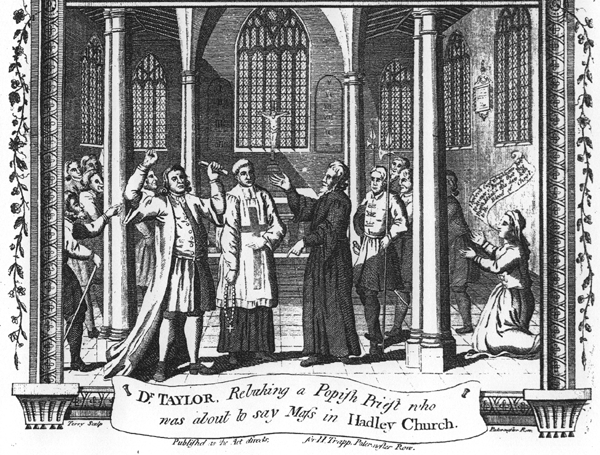 The Life and Conduct of Dr. Rowland Taylor of Hadley
Dr. Rowland Taylor, vicar of Hadley, in Suffolk, was a man of eminent learning, and had been admitted to the degree of doctor of the civil and canon law.
His attachment to the pure and uncorrupted principles of Christianity recommended him to the favor and friendship of Dr. Cranmer, archbishop of Canterbury, with whom he lived a considerable time, until through his interest he obtained the living at Hadley.
Not only was his word a preaching unto them, but all his life and conversation was an example of unfeigned Christian life and true holiness. He was void of all pride, humble and meek as any child; so that none were so poor but they might boldly, as unto their father, resort unto him; neither was his lowliness childish or fearful, but, as occasion, time, and place required, he would be stout in rebuking the sinful and evildoers; so that none was so rich but he would tell them plainly his fault, with such earnest and grave rebukes as became a good curate and pastor. He was a man very mild, void of all rancor, grudge or evil will; ready to do good to all men; readily forgiving his enemies; and never sought to do evil to any.
To the poor that were blind, lame, sick, bedrid, or that had many children, he was a very father, a careful patron, and diligent provider, insomuch that he caused the parishioners to make a general provision for them; and he himself (beside the continual relief that they always found at his house) gave an honest portion yearly to the common almsbox. His wife also was an honest, discreet, and sober matron, and his children well nurtured, brought up in the fear of God and good learning.
He was a good salt of the earth, savorly biting the corrupt manners of evil men; a light in God's house, set upon a candlestick for all good men to imitate and follow.
Thus continued this good shepherd among his flock, governing and leadning them through the wilderness of this wicked world, all the days of the most innocent and holy king of blessed memory, Edward VI. But on his demise, and the succession of Queen Mary to the throne, he escaped not the cloud that burst on so many besdie; for two of his parishioners, Foster, an attorney, and Clark, a tradesman, out of blind zeal, resolved that Mass should be celebrated, in all its superstitious forms, in the parish church of Hadley, on Monday before Easter. This Dr. Taylor, entering the church, strictly forbade; but Clark forced the Doctor out of the church, celebrated Mass, and immediately informed the lord-chancellor, bishop of Winchester of his behavior, who summoned him to appear, and answer the complaints that were alleged against him.
The doctor upon the receipt of the summons, cheerfully prepared to obey the same; and rejected the advice of his friends to fly beyond sea. When Gardiner saw Dr. Taylor, he, according to his common custom, reviled him. Dr. Taylor heard his abuse patiently, and when the bishop said, "How darest thou look me in the face! knowest thou not who I am?" Dr. Taylor replied, "You are Dr. Stephen Gardiner, bishop of Winchester, and lord-chancellor, and yet but a mortal man. But if I should be afraid of your lordly looks, why fear ye not God, the Lord of us all? With what countenance will you appear before the judgment seat of Christ, and answer to your oath made first unto King Henry VIII, and afterward unto King Edward VI, his son?"
A long conversation ensued, in which Dr. Taylor was so piously collected and severe upon his antagonist, that he exclaimed:
"Thou art a blasphemous heretic! Thou indeed blasphemist the blessed Sacrament, (here he put off his cap) and speakest against the holy Mass, which is made a sacrifice for the quick and the dead." The bishop afterward committed him into the king's bench.
When Dr. Taylor came there, he found the virtuous and vigilant preacher of God's Word, Mr. Bradford; who equally thanked God that He had provided him with such a comfortable fellow-prisoner; and they both together praised God, and continued in prayer, reading and exhorting one another.
After Dr. Taylor had lain some time in prison, he was cited to appear in the arches of Bow-church.
Dr. Taylor being condemned, was committed to the Clink, and the keepers were charged to treat him roughly; at night he was removed to the Poultry Compter.
When Dr. Taylor had lain in the Compter about a week on the fourth of February, Bonner came to degrade him, bringing with him such ornaments as appertained to the massing mummery; but the Doctor refused these trappings until they were forced upon him.
The night after he was degraded his wife came with John Hull, his servant, and his son Thomas, and were by the gentleness of the keepers permitted to sup with him.
After supper, walking up and down, he gave God thanks for His grace, that had given him strength to abide by His holy Word. With tears they prayed together, and kissed one another. Unto his son Thomas he gave a Latin book, containing the notable sayings of the old martyrs, and in the end of that he wrote his testament:
"I say to my wife, and to my children, The Lord gave you unto me, and the Lord hath taken me from you, and you from me: blessed be the name of the Lord! I believe that they are blessed which die in the Lord. God careth for sparrows, and for the hairs of our heads. I have ever found Him more faithful and favorable, than is any father or husband. Trust ye therefore in Him by the means of our dear Savior Christ's merits: believe, love, fear, and obey Him: pray to Him, for He hath promised to help. Count me not dead, for I shall certainly live, and never die. I go before, and you shall follow after, to our long home."
On the morrow the sheriff of London with his officers came to the Compter by two o'clock in the morning, and brought forth Dr. Taylor; and without any light led him to the Woolsack, an inn without Aldgate. Dr. Taylor's wife, suspecting that her husband should that night be carried away, watched all night in St. Botolph's church-porch beside Aldgate, having her two children, the one named Elizabeth, of thirteen years of age (whom, being left without father or mother, Dr. Taylor had brought up of alms from three years old), the other named Mary, Dr. Taylor's own daughter.
Now, when the sheriff and his company came against St.
Botolph's church, Elizabeth cried, saying, "O my dear father! mother, mother, here is my father led away." Then his wife cried, "Rowland, Rowland, where art thou?"-for it was a very dark morning, that the one could not well see the other. Dr. Taylor answered, "Dear wife, I am here"; and stayed. The sheriff's men would have led him forth, but the sheriff said, "Stay a little, masters, I pray you; and let him speak to his wife"; and so they stayed.
Then came she to him, and he took his daughter Mary in his arms; and he, his wife, and Elizabeth kneeled down and said the Lord's Prayer, at which sight the sheriff wept apace, and so did divers others of the company. After they had prayed, he rose up and kissed his wife, and shook her by the hand, and said, "Farewell, my dear wife; be of good comfort, for I am quiet in my conscience. God shall stir up a father for my children."
All the way Dr. Taylor was joyful and merry, as one that ccounted himself going to a most pleasant banquet or bridal. He spake many notable things to the sheriff and yeomen of the guard that conducted him, and often moved them to weep, through his much earnest calling upon them to repent, and to amend their evil and wicked living. Oftentimes also he caused them to wonder and rejoice, to see him so constant and steadfast, void of all fear, joyful in heart, and glad to die.
When Dr. Taylor had arrived at Aldham Common, the place where he should suffer, seeing a great multitude of people, he asked, "What place is this, and what meaneth it that so much people are gathered hither?" It was answered, "It is Aldham Common, the place where you must suffer; and the people have come to look upon you." Then he said, "Thanked be God, I am even at home"; and he alighted from his horse and with both hands rent the hood from his head.
His head had been notched and clipped like as a man would clip a fool's; which cost the good bishop Bonner had bestowed upon him. But when the people saw his reverend and ancient face, with a long white beard, they burst out with weeping tears, and cried, saying: "God save thee, good Dr. Taylor! Jesus Christ strengthen thee, and help thee! the Holy Ghost comfort thee!" with such other like good wishes.
When he had prayed, he went to the stake and kissed it, and set himself into a pitch barrel, which they had put for him to stand in, and stood with his back upright against the stake, with his hands folded together, and his eyes towards heaven, and continually prayed.
They then bound him with the chains, and having set up the fagots, one Warwick cruelly cast a fagot at him, which struck him on his head, and cut his face, sot hat the blood ran down. Then said Dr. Taylor, "O friend, I have harm enough; what needed that?"
Sir John Shelton standing by, as Dr. Taylor was speaking, and saying the Psalm Miserere in English, struck him on the lips:
"You knave," he said, "speak Latin: I will make thee." At last they kindled the fire; and Dr. Taylor holding up both his hands, calling upon God, and said, "Merciful Father of heaven! for Jesus Christ, my Savior's sake, receive my soul into Thy hands!" So he stood still without either crying or moving, with his hands folded together, until Soyce, with a halberd struck him on the head until his brains fell out, and the corpse fell down into the fire.
Thus rendered up this man of God his blessed soul into the hands of his merciful Father, and to his most dear Savior Jesus Christ, whom he most entirely loved, faithfully and earnestly preached, obediently followed in living, and constantly glorified in death.
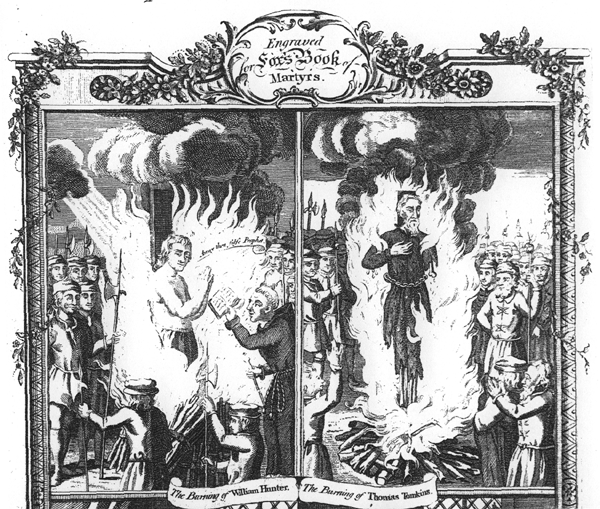 Martyrdom of William Hunter
William Hunter had been trained to the doctrines of the Reformation from his earliest youth, being descended from religious parents, who carefully instructed him in the principles of true religion.
Hunter, then nineteen years of age, refusing to receive the communion at Mass, was threatened to be brought before the bishop; to whom this valiant young martyr was conducted by a constable.
Bonner caused William to be brought into a chamber, where he began to reason with him, proimising him security and pardon if he would recant. Nay, he would have been content if he would have gone only to receive and to confession, but William would not do so for all the world.
Upon this the bishop commanded his men to put William in the stocks in his gate house, where he sat two days and nights, with a crust of brown bread and a cup of water only, which he did not touch.
At the two days' end, the bishop came to him, and finding him steadfast in the faith, sent him to the convict prison, and commanded the keeper to lay irons upon him as many as he could bear. He continued in prison three quarters of a year, during which time he had been before the bishop five times, besides the time when he was condemned in the consistory in St. Paul's, February 9, at which time his brother, Robert Hunter, was present.
Then the bishop, calling William, asked him if he would recant, and finding he was unchangeable, pronounced sentence upon him, that he should go from that place to Newgate for a time, and thence to Brentwood, there to be burned.
About a month afterward, William was sent down to Brentwood, where he was to be executed. On coming to the stake, he knelt down and read the Fifty-first Psalm, until he came to these words, "The sacrifices of God are a broken spirit; a broken and a contrite heart, O God, Thou wilt not despise." Steadfast in refusing the queen's pardon, if he would become an apostate, at length one Richard Ponde, a bailiff, came, and made the chain fast about him.
William now cast his psalter into his brother's hand, who said, "William, think on the holy passion of Christ, and be not afraid of death." "Behold," answered William, "I am not afraid." Then he lifted up his hands to heaven, and said, "Lord, Lord, Lord, receive my spirit;" and casting down he head again into the smothering smoke, he yielded up his life for the truth, sealing it with his blood to the praise of God.
This worthy and learned prelate, the bishop of St. David's in Wales, having in the former reign, as well as since the accession of Mary, been remarkably zealous in promoting the reformed doctrines, and exploding the rrors of popish idolatry, was summoned, among others, before the persecuting bishop of Winchester, and other commissioners set apart for the abominable work of devastation and massacre.
His principal accusers and persecutors, on a charge of praemunire in the reign of Edward VI were George Constantine Walter, his servant; Thomas Young, chanter of the cathedral, afterward bishop of Bangor, etc. Dr. Farrar ably replied to the copies of information laid against him, consisting of fifty-six articles. The whole process of this trial was long and tedious. Delay succeeded delay, and after that Dr. Farrar had been long unjustly detained in custody under sureties, in the reign of King Edward, because he had been promoted by the duke of Somerset, whence after his fall he found fewer friends to support him against such as wanted his bishopric by the coming in of Queen Mary, he was accused and examined not for any matter of praemunire, but for his faith and doctrine; for which he was called before the bishop of Winchester with Bishop Hooper, Mr. Rogers, Mr. Bradford, Mr. Saunders, and others, February 4, 1555; on which day he would also with them have been condemned, but his condemnation was deferred, and he sent to prison again, where he continued until February 14, and then was sent into Wales to receive sentence. He was six times brought up before Henry Morgan, bishop of St. David's, who demanded if he would abjure; from which he zealously dissented, and appealed to Cardinal Pole; notwithstanding which, the bishop, proceeding in his rage, pronounced him a heretic excommunicate, and surrendered him to the secular power.
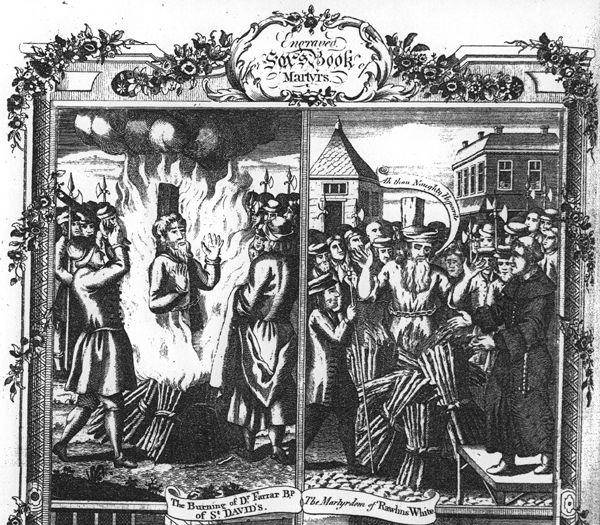
Dr. Farrar, being condemned and degraded, was not long after brought to the place of execution in the town of Carmathen, in the market-place of which, on the south side of the market-cross, March 30, 1555, being Saturday next before Passion Sunday, he most constantly sustained the torments of the fire.
Concerning his constancy, it is said that one Richard Jones, a knight's son, coming to Dr. Farrar a little before his death, seemed to lament the painfulness of the death he had to suffer; to whom the bishop answered that if he saw him once stir in the pains of his burning, he might then give no credit to his doctrine; and as he said, so did he maintain his promise, patiently standing without emotion, until one Richard Gravell with a staff struck him down.
 Martyrdom of Rawlins White
Rawlins White was by his calling and occupation a fisherman, living and continuing in the said trade for the space of twenty years at least, in the town of Cardiff, where he bore a very good name amongst his neighbors.
Though the good man was altogether unlearned, and withal very simple, yet it pleased God to remove him from error and idolatry to a knowledge of the truth, through the blessed Reformation in Edward's reign. He had his son taught to read English, and after the little boy could read pretty well, his father every night after supper, summer and winter, made the boy read a portion of the Holy Scriptures, and now and then a part of some other good book.
When he had continued in his profession the space of five years, King Edward died, upon whose decease Queen Mary succeeded and with her all kinds of superstition crept in. White was taken by the officers of the town, as a man suspected of heresy, brought before the Bishop Llandaff, and committed to prison in Chepstow, and at last removed to the castle of Cardiff, where he continued for the space of one whole year. Being brought before the bishop in his chapel, he counselled him by threats and promises. But as Rawlins would in no wise recant his opinions, the bishop told him plainly that he must proceed against him by law, and condemn him as a heretic.
Before they proceeded to this extremity, the bishop proposed that prayer should be said for his conversion. "This," said White, "is like a godly bishop, and if your request be godly and right, and you pray as you ought, no doubt God will hear you; pray you, therefore, to your God, and I will pray to my God." After the bishop and his party had done praying, he asked Rawlins if he would now revoke. "You find," said the latter, "your prayer is not granted, for I remain the same; and God will strengthen me in support of this truth." After this, the bishop tried what saying Mass would do; but Rawlins called all the people to witness that he did not bow down to the host. Mass being ended, Rawlins was called for again; to whom the bishop used many persuasions; but the blessed man continued so steadfast in his former profession that the bishop's discourse was to no purpose. The bishop now caused the definitive sentence to be read, which being ended, Rawlins was carried again to Cardiff, to a loathsome prison in the town, called Cockmarel, where he passed his time in prayer, and in the singing of Psalms. In about three weeks the order came from town for his execution.
When he came to the place, where his poor wife and children stood weeping, the sudden sight of them so pierced his heart, that the tears trickled down his face. Being come to the altar of his sacrifice, in going toward the stake, he fell down upon his knees, and kissed the ground; and in rising again, a little earth sticking on his face, he said these words. "Earth unto earth, and dust unto dust; thou art my mother, and unto thee I shall return."
When all things were ready, directly over against the stake, in the face of Rawlins White, there was a stand erected, whereon stepped up a priest, addressing himself to the people, but, as he spoke of the Romish doctrines of the Sacraments, Rawlins cried out, "Ah! thou wicked hypocrite, dost thou presume to prove thy false doctrine by Scripture? Look in the text that followeth; did not Christ say, 'Do this in remembrance of me?'"
Then some that stood by cried out, "Put fire! set on fire!" which being done, the straw and reeds cast up a great and sudden flame. In which flame this good man bathed his hands so long, until such time as the sinews shrank, and the fat dropped away, saving that once he did, as it were, wipe his face with one of them. All this while, which was somewhat long, he cried with a loud voice, "O Lord, receive my spirit!" until he could not open his mouth. At last the extremity of the fire was so vehement against his legs that they were consumed almost before the rest of his body was hurt, which made the whole body fall over the chains into the fire sooner than it would have done. Thus died this good old man for his testimony of God's truth, and is now rewarded, no doubt, with the crown of eternal life.
George Marsh, born in the parish of Deane, in the county of Lancaster, received a good education and trade from his parents; about his twenty-fifth year he married, and lived, blessed with several children, on his farm until his wife died. He then went to study at Cambridge, and became the curate of Rev. Lawrence Saunders, in which duty he constantly and zealously set forth the truth of God's Word, and the false doctrines of the modern Antichrist.
Being confined by Dr. Coles, the bishop of Chester, within the precincts of his own house, he was dept from any intercourse with his friends during four months; his friends and mother, earnestly wished him to have flown from "the wrath to come;" but Mr. Marsh thought that such a step would ill agree with that profession he had during nine years openly made. He, however, secreted himself, but he had much struggling, and in secret prayer begged that God would direct him, through the advice of his best friends, for his own glory and to what was best. At length, determined by a letter he received, boldly to confess the faith of Christ, he took leave of his mother-in-law and other friends, recommending his children to their care and departed for Smethehills, whence he was, with others, conducted to Lathum, to undergo examination before the earl of Derby, Sir William Nores, Mr. Sherburn, the parson of Garpnal, and others. The various questions put to him he answered with a good conscience, but when Mr. Sherburn interrogated him upon his belief of the Sacrament of the altar, Mr. Marsh answered like a true Protestant that the essence of the bread and wine was not at all changed, hence, after receiving dreadful threats from some, and fair words from others, for his opinions, he was remanded to ward, where he lay two nights without any bed.
On Palm Sunday he underwent a second examination, and Mr.
Marsh much lamented that his fear should at all have induced him to prevaricate, and to seek his safety, as long as he did not openly deny Christ; and he again cried more earnestly to God for strength that he might not be overcome by the subtleties of those who strove to overrule the purity of his faith. He underwent three examinations before Dr. Coles, who, finding him steadfast in the Protestant faith, began to read his sentence; but he was interrupted by the chancellor, who prayed the bishop to stay before it was too late. The priest then prayed for Mr. Marsh, but the latter, upon being again solicited to recant, said he durst not deny his Savior Christ, lest he lose His everlasting mercy, and so obtain eternal death. The bishop then proceeded in the sentence. He was committed to a dark dungeon, and lay deprived of the consolation of any one (for all were afraid to relieve or communicate with him) until the day appointed came that he should suffer. The sheriffs of the city, Amry and Couper, with their officers, went to the north gate, and took out Mr. George Marsh, who walked all the way with the Book in his hand, looking upon the same, whence the people said, "This man does not go to his death as a thief, nor as one that deserveth to die."
When he came to the place of execution without the city, near Spittal=Boughton, Mr. Cawdry, deputy chamberlain of Chester, showed Mr. Marsh a writing under a great seal, saying that it was a pardon for him if he would recant. He answered that he would gladly accept the same did it not tend to pluck him from God.
After that, he began to speak to the people showing the cause of his death, and would have exhorted them to stick unto Christ, but one of the sheriffs prevented him. Kneeling down, he then said his prayers, put off his clothes unto his shirt, and was chained to the post, having a number of fagots under him, and a thing made like a firkin, with pitch and tar in it, over his head. The fire being unskilfully made, and the wind driving it in eddies, he suffered great extremity, which notwithstanding he bore with Christian fortitude.
When he had been a long time tormented in the fire without moving, having his flesh so broiled and puffed up that they who stood before him could not see the chain wherewith he was fastened, and therefore supposed that he had been dead, suddenly he spread abroad his arms, saying, "Father of heaven have mercy upon me!" and so yielded his spirit into the hands of the Lord. Upon this, many of the people said he was a martyr, and died gloriously patient. This caused the bishop shortly after to make a sermon in the cathedral church, and therein he affirmed, that the said 'Marsh was a heretic, burnt as such, and is a firebrand in hell.' Mr. Marsh suffered April 24, 1555.
William Flower, otherwise Branch, was born at Snow-hill, in the county of Cambridge, where he went to school some years, and then came to the abby of Ely. After he had remained a while he became a professed monk, was made a priest in the same house, and there celebrated and sang Mass. After that, by reason of a visitation, and certain injunctions by the authority of Henry VIII he took upon him the habit of a secular priest, and returned to Snow-hill, where he was born, and taught children about half a year.
He then went to Ludgate, in Suffolk, and served as a secular priest about a quarter of a year; from thence to Stoniland; at length to Tewksbury, where he married a wife, with whom he ever after faithfully and honestly continued. After marriage he resided at Tewksbury about two years, and thence went to Brosley, where he practiced physic and surgery; but departing from those parts he came to London, and finally settled at Lambeth, where he and his wife dwelt together. However, he was generally abroad, excepting once or twice in a month, to visit and see his wife. Being at home upon Easter Sunday morning, he came over the water from lambeth into St. Margaret's Church at Westminster; when seeing a priest, named John Celtham, administering and giving the Sacrament of the alter to the people, and being greatly offended in his conscience with the priest for the same, he struck and wounded him upon the head, and also upon the arm and hand, with his wood knife, the priest having at the same time in his hand a chalice with the consecrated host therein, which became sprinkled with blood.
Mr. Flower, for this injudicious zeal, was heavily ironed, and put into the gatehouse at Westminster; and afterward summoned before bishop Bonner and his ordinary, where the bishop, after he had sworn him upon a Book, ministered articles and interrogatories to him.
After examination, the bishop began to exhort him again to return to the unity of his mother the Catholic Church, with many fair promises. These Mr. Flower steadfastly rejecting, the bishop ordered him to appear in the same place in the afternoon, and in the meantime to consider well his former answer; but he, neither apologizing for having struck the priest, nor swerving from his faith, the bishop assigned him the next day, April 20, to receive sentence if he would not recant. The next morning, the bishop accordingly proceeded to the sentence, condemning and excommunicating him for a heretic, and after pronouncing him to be degraded, committed him to the secular power.
On April 24, St. Mark's eve, he was brought to the place of martyrdom, in St. Margaret's churchyard, Westminster, where the fact was committed: and there coming to the stake, he prayed to Almighty God, made a confession of his faith, and forgave all the world.
This done, his hand was held up against the stake, and struck off, his left hand being fastened behind him. Fire was then set to him, and he burning therein, cried with a loud voice, "O Thou Son of God receive my soul!" three times. His speech being now taken from him, he spoke no more, but notwithstanding he lifted up the stump with his other arm as long as he could.
Thus he endured the extremity of the fire, and was cruelly tortured, for the few fagots that were brought being insufficient to burn him they were compelled to strike him down into the fire, where lying along upon the ground, his lower part was consumed in the fire, whilst his upper part was little injured, his tongue moving in his mouth for a considerable time.
May 30, 1555, the Rev. John Cardmaker, otherwise called Taylor, prebendary of the Church of Wells, and John Warne, upholsterer, of St. John's, Walbrook, suffered together in Smithfield. Mr. Cardmaker, who first was an observant friar before the dissolution of the abbeys, afterward was a married minister, and in King Edward's time appointed to be a reader in St. Paul's; being apprehended in the beginning of Queen Mary's reign, with Dr. Barlow, bishop of Bath, he was brought to London, and put in the Fleet prison, King Edward's laws being yet in force. In Mary's reign, when brought before the bishop of Winchester, the latter offered them the queen's mercy, if they would recant.
Articles having been preferred against Mr. John Warne, he was examined upon them by Bonner, who earnestly exhorted him to recant his opinions, to whom he answered, "I am persuaded that I am in the right opinion, and I see no cause to recant; for all the filthiness and idolatry lies in the Church of Rome."
The bishop then, seeing that all his fair promises and terrible threatenings could not prevail, pronounced the definitive sentence of condemnation, and ordered May 30, 1555, for the execution of John Cardmaker and John Warne, who were brought by the sheriffs to Smithfield. Being come to the stake, the sheriffs called Mr. Cardmaker aside, and talked with him secretly, during which Mr. Warne prayed, was chained to the stake, and had wood and reeds set about him.
The people were greatly afflicted, thinking that Mr. Cardmaker would recant at the burning of Mr. Warne. At length Mr. Cardmaker departed from the sheriffs, and came towards the stake, knelt down, and made a long prayer in silence to himself. He then rose up, put off his clothes to his shirt, and went with a bold courage unto the stake and kissed it; and taking Mr. Warne by the hand, he heartily comforted him, and was bound to the stake, rejoicing. The people seeing this so suddenly done, contrary to their previous expectation, cried out, "God be praised! the Lord strengthen thee, Cardmaker! the Lord Jesus receive thy spirit!" And this continued while the executioner put fire to them, and both had passed through the fire to the blessed rest and peace among God's holy saints and martyrs, to enjoy the crown of triumph and victory prepared for the elect soldiers and warriors of Christ Jesus in His blessed Kingdom, to whom be glory and majesty forever. Amen.
John Simpson and John Ardeley were condemned on the same day with Mr. Carmaker and John Warne, which was the twenty-fifth of May. They were shortly after sent down from London to Essex, where they were burnt in one day, John Simpson at Rochford, and John Ardeley at Railey, glorifying God in His beloved Son, and rejoicing that they were accounted worthy to suffer.
 Thomas Haukes, Thomas Watts, and Anne Askew
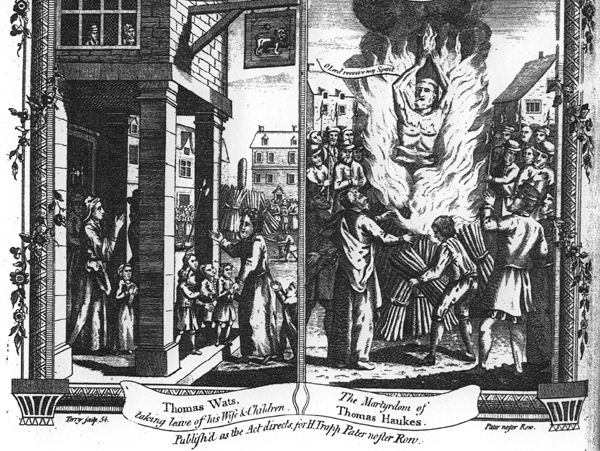
Thomas Haukes, with six others, was condemned on the ninth of February, 1555. In education he was erudite; in person, comely, and of good stature; in manners, a gentleman, and a sincere Christian. A little before death, several of Mr. Hauke's friends, terrified by the sharpness of the punishment he was going to suffer, privately desired that in the midst of the flames he should show them some token, whether the pains of burning were so great that a man might not collectedly endure it. This he promised to do; and it was agreed that if the rage of the pain might be suffered, then he should lift up his hands above his head towards heaven, before he gave up the ghost.
Not long after, Mr. Haukes was led away to the place appointed for slaughter by Lord Rich, and being come to the stake, mildly and patiently prepared himself for the fire, having a strong chain cast about his middle, with a multitude of people on every side compassing him about, unto whom after he had spoken many things, and poured out his soul unto God, the fire was kindled.
When he had continued long in it, and his speech was taken away by violence of the flame, his skin drawn together, and his fingers consumed with the fire, so that it was thought that he was gone, suddenly and contrary to all expectation, this good man being mindful of his promise, reached up his hands burning in flames over his head to the living God, and with great rejoicings as it seemed, struck or clapped them three times together. A great shout followed this wonderful circumstance, and then this blessed martyr of Christ, sinking down in the fire, gave up his spirit, June 10, 1555.
Thomas Watts, of Billerica, in Essex, of the diocese of London, was a linen draper. He had daily expected to be taken by God's adversaries, and this came to pass on the fifth of April, 1555, when he was brought before Lord Rich, and other commissioners at Chelmsford, and accused for not coming to the church.
Being consigned over to the bloody bishop, who gave him several hearings, and, as usual, many arguments, with much entreaty, that he would be a disciple of Antichrist, but his preaching availed not, and he resorted to his last revenge-that of condemnation.
At the stake, after he had kissed it, he spake to Lord Rich, charging him to repent, for the Lord would revenge his death. Thus did this good martyr offer his body to the fire, in defence of the true Gospel of the Savior.
Thomas Osmond, William Bamford, and Nicholas Chamberlain, all of the town of Coxhall, being sent up to be examined, Bonner, after several hearings, pronounced them obstinate heretics, and delivered them to the sheriffs, in whose custody they remained until they were delivered to the sheriff of Essex county, and by him were executed, Chamberlain at Colchester, the fourteenth of June; Thomas Osmond at Maningtree, and William Bamford, alias Butler, at Harwich, the fifteenth of June, 1555; all dying full of the glorious hope of immortality.
Then Wriotheseley, lord chancellor, offered Anne Askew the king's pardon if she would recant; who made this answer, that she came not thither to deny her Lord and Master. And thus the good Anne Askew, being compassed in with flames of fire, as a blessed sacrifice unto God, slept in the Lord, A.D. 1546, leaving behind her a singular example of Christian constancy for all men to follow.
Rev. John Bradford was born at Manchester, in Lancashire; he was a good Latin scholar, and afterward became a servant of Sir John Harrington, knight.
He continued several years in an honest and thriving way; but the Lord had elected him to a better function. Hence he departed from his master, quitting the Temple, at London, for the University of Cambridge, to learn, by God's law, how to further the building of the Lord's temple. In a few years after, the university gave him the degree of master of arts, and he became a fellow of Pembroke Hall.
Martin Bucer first urged him to preach, and when he modestly doubted his ability, Bucer was wont to reply, "If thou hast not fine wheat bread, yet give the poor people barley bread, or whatsoever else the Lord hath committed unto thee." Dr. Ridley, that worthy bishop of London, and glorious martyr of Christ, first called him to take the degree of a deacon and gave him a prebend in his cathedral Church of St. Paul.
In this preaching office Mr. Bradford diligently labored for the space of three years. Sharply he reproved sin, sweetly he preached Christ crucified, ably he disproved heresies and errors, earnestly he persuaded to godly life. After the death of blessed King Edward VI Mr. Bradford still continued diligent in preaching, until he was suppressed by Queen Mary.
An act now followed of the blackest ingratitude, and at which a pagan would blush. It has been recited, that a tumult was occasioned by Mr. Bourne's (then bishop of Bath) preaching at St. Paul's Cross; the indignation of the people placed his life in imminent danger; indeed a dagger was thrown at him. In this situation he entreated Mr. Bradford, who stood behind him. to speak in his place, and assuage the tumult. The people welcomed Mr. Bradford, and the latter afterward kept close to him, that his presence might prevent the populace from renewing their assaults.
The same Sunday in the afternoon, Mr. Bradford preached at Bow Church in Cheapside, and reproved the people sharply for their seditious misdemeanor. Notwithstanding this conduct, within three days after, he was sent for to the Tower of London, where the queen then was, to appear before the Council. There he was charged with this act of saving Mr. Bourne, which was called seditious, and they also objected against him for preaching. Thus he was committed, first to the Tower, then to other prisons, and, after his condemnation, to the Poultry Compter, where he preached twice a day continually, unless sickness hindered him. Such as his credit with the keeper of the king's Bench, that he permitted him in an evening to visit a poor, sick person near the steel-yard, upon his promise to return in time, and in this he never failed.
The night before he was sent to Newgate, he was troubled in his sleep by foreboding dreams, that on Monday after he should be burned in Smithfield. In the afternoon the keeper's wife came up and announced this dreadful news to him, but in him it excited only thankfulness to God. At night half a dozen friends came, with whom he spent all the evening in prayer and godly exercises.
When he was removed to Newgate, a weeping crowd accompanied him, and a rumor having been spread that he was to suffer at four the next morning, an immense multitude attended. At nine o'clock Mr. Bradford was brought into Smithfield. The cruelty of the sheriff deserves notice; for his brother-in-law, Roger Beswick, having taken him by the hand as he passed, Mr. Woodroffe, with his staff, cut his head open.
Mr. Bradford, being come to the place, fell flat on the ground, and putting off his clothes unto the shirt, he went to the stake, and there suffered with a young man of twenty years of age, whose name was John Leaf, an apprentice to Mr. Humphrey Gaudy, tallow-chandler, of Christ-church, London. Upon Friday before Palm Sunday, he was committed to the Compter in Bread-street, and afterward examined and condemned by the bloody bishop.
It is reported of him, that, when the bill of his confession was read unto him, instead of pen, he took a pin, and pricking his hand, sprinkled the blood upon the said bill, desiring the reader thereof to show the bishop that he had sealed the same bill with his blood already.
They both ended this mortal life, July 12, 1555, like two lambs, without any alteration of their countenances, hoping to obtain that prize they had long run for; to which may Almighty God conduct us all, through the merits of Christ our Savior!
We shall conclude this article with mentioning that Mr.
Sheriff Woodroffe, it is said, within half a year after, was struck on the right side with a palsy, and for the space of eight years after, (until his dying day,) he was unable to turn himself in his bed; thus he became at last a fearful object to behold.
The day after Mr. Bradford and John Leaf suffered in Smithfield William Minge, priest, died in prison at Maidstone. With as great constancy and boldness he yielded up his life in prison, as if it had pleased God to have called him to suffer by fire, as other godly men had done before at the stake, and as he himself was ready to do, had it pleased God to have called him to this trial.
These Christian persons were all burnt at Canterbury for the same cause. Frankesh and Bland were ministers and preachers of the Word of God, the one being parson of Adesham, and the other vicar of Rolvenden. Mr. Bland was cited to answer for his opposition to antichristianism, and underwent several examinations before Dr. Harpsfield, archdeacon of Canterbury, and finally on the twenty-fifth of June, 1555, again withstanding the power of the pope, he was condemned, and delivered to the secular arm. On the same day were condemned John Frankesh, Nicholas Shetterden, Humphrey Middleton, Thacker, and Crocker, of whom Thacker only recanted.
Being delivered to the secular power, Mr. Bland, with the three former, were all burnt together at Canterbury, July 12, 1555, at two several stakes, but in one fire, when they, in the sight of God and His angels, and before men, like true soldiers of Jesus Christ, gave a constant testimony to the truth of His holy Gospel.
The twenty-second of July, 1555, Dirick Carver, brewer, of Brighthelmstone, aged forty, was burnt at Lewes. And the day following John Launder, husbandman, aged twenty-five, of Godstone, Surrey, was burnt at Stening.
Dirick Carver was a man whom the Lord had blessed as well with temporal riches as with his spiritual treasures. At his coming into the town of Lewes to be burnt, the people called to him, beseeching God to strengthen him in the faith of Jesus Christ; and, as he came to the stake, he knelt down, and prayed earnestly. Then his Book was thrown into the barrel, and when he had stripped himself, he too, went into a barrel. As soon as he was in, he took the Book, and threw it among the people, upon which the sheriff commanded, in the name of the king and queen, on pain of death , to throw in the Book again. And immediately the holy martyr began to address the people. After he had prayed a while, he said, "O Lord my God, Thou hast written, he that will not forsake wife, children, house, and every thing that he hath, and take up Thy cross and follow Thee, is not worthy of Thee! but Thou, Lord, knowest that I have forsaken all to come unto Thee. Lord, have mercy upon me, for unto Thee I commend my spirit! and my soul doth rejoice in Thee!" These were the last words of this faithful servant of Christ before enduring the fire. And when the fire came to him, he cried, "O Lord, have mercy upon me!" and sprang up in the fire, calling upon the name of Jesus, until he gave up the ghost.
James Abbes. This young man wandered about to escape apprehension, but was at last informed against, and brought before the bishop of Norwich, who influenced him to recant; to secure him further in apostasy, the bishop afterward gave him a piece of money; but the interference of Providence is here remarkable. This bribe lay so heavily upon his conscience, that he returned, threw back the money, and repented of his conduct. Like Peter, he was contrite, steadfast in the faith, and sealed it with his blood at Bury, August 2, 1555, praising and glorifying God.
Mr. Denley and Newman were returning one day to Maidstone, the place of their abode, when they were met by E. Tyrrel, Esq., a bigoted justice of the peace in Essex, and a cruel persecutor of the Protestants. He apprehended them merely on suspicion. On the fifth of July, 1555, they were condemned, and consigned to the sheriffs, who sent Mr. Denley to Uxbridge, where he perished, August eighth, 1555. While suffering in agony, and singing a Psalm, Dr. Story inhumanly ordered one of the tormentors to throw a fagot at him, which cut his face severely, caused him to cease singing, and to raise his hands to his face. Just as Dr. Story was remarking in jest that he had spoiled a good song, the pious martyr again changed, spread his hands abroad in the flames, and through Christ Jesus resigned his soul into the hands of his Maker.
Mr. Packingham suffered at the same town on the twenty-eigth of the same month.
Mr. Newman, pewterer, was burnt at Saffron Waldon, in Essex, August 31, for the same cause, and Richard Hook about the same time perished at Chichester.
These persons all of Kent, were examined at the same time with Mr. Bland and Shetterden, by Thornton, bishop of Dover, Dr. Harpsfield, and others. These six martyrs and witnesses of the truth were consigned to the flames in Canterbury, at the end of August, 1555.
Elizabeth Warne, widow of John Warne, upholsterer, martyr, was burnt at Stratford-le-bow, near London, at the end of August, 1555.
George Tankerfield, of London, cook, born at York, aged twenty-seven, in the reign of Edward VI had been a papist; but the cruelty of bloody Mary made him suspect the truth of those doctrines which were enforced by fire and torture. Tankerfield was imprisoned in Newgate about the end of February, 1555, and on August 26, at St. Alban's, he braved the excruciating fire, and joyfully died for the glory of his Redeemer.
Rev. Robert Smith was first in the service of Sir T. Smith, provost of Eton; and was afterward removed to Windsor, where he had a clerkship of ten pounds a year.
He was condemned, July 12, 1555, and suffered August 8, at Uxbridge. He doubted not but that God would give the spectators some token in support of his own cause; this actually happened; for, when he was nearly half burnt, and supposed to be dead, he suddenly rose up, moved the remaining parts of his arms and praised God, then, hanging over the fire, he sweetly slept in the Lord Jesus.
Mr. Stephen Harwood and Mr. Thomas Fust suffered about the same time with Smith and Tankerfield, with whom they were condemned. Mr. William Hale also, of Thorp, in Essex, was sent to Barnet, where about the same time he joined the ever-blessed company of martyrs.
George King, Thomas Leyes, and John Wade, falling sick in Lollard's Tower, were removed to different houses, and died. Their bodies were thrown out in the common fields as unworthy of burial, and lay until the faithful conveyed them away at night.
Mr. William Andrew of Horseley, Essex, was imprisoned in Newgate for heresy; but God chose to call him to himself by the severe treatment he endured in Newgate, and thus to mock the snaguinary expectations of his Catholic persecutors. His body was thrown into the open air, but his soul was received into the everlasting mansions of his heavenly Creator.
This gentleman was minister ofr Bradford, Suffolk, where he industriously taught the flock committed to his charge, while he was openly permitted to discharge his duty. He was first persecuted by Mr. Foster, of Copdock, near Ipswich, a severe and bigoted persecutor of the followers of Christ, according to the truth in the Gospel. Notwithstanding Mr. Samuel was ejected from his living, he continued to exhort and instruct privately; nor would he obey the order for putting away his wife, whom he had married in King Edward's reign; but kept her at Ipswich, where Foster, by warrant, surprised him by night with her. After being imprisoned in Ipswich jail, he was taken before Dr. Hopton, bishop of Norwich, and Dr. Dunnings, his chancellor, two of the most sanguinary among the bigots of those days. To intimidate the worthy pastor, he was in prison chained to a post in such a manner that the weight of his body was supported by the points of his toes: added to this his allowance of provision was reduced to a quantity so insufficient to sustain nature that he was almost ready to devour his own flesh. From this dreadful extremity there was even a degree of mercy in ordering him to the fire. Mr. Samuel suffered August 31, 1555.
These reverend prelates suffered October 17, 5555, at Oxford, on the same day Wolsey and Pygot perished at Ely. Pillars of the Church and accomplished ornaments of human nature, they were the admiration of the realm, amiably conspicuous in their lives, and glorious in their deaths.
Dr. Ridley was born in Northumberland, was first tauht grammar at Newcastle, and afterward removed to Cambridge, where his aptitude in education raised him gradually until he came to be the head of Pembroke College, where he received the title of Doctor of Divinity. Having returned from a trip to Paris, he was appointed chaplain by Henry VIII and bishop of Rochester, and was afterwards translated to the see of London in the time of Edward VI.
To his sermons the people resorted, swarming about him like bees, coveting the sweet flowers and wholesome juice of the fruitful doctrine, which he did not only preach, but showed the same by his life, as a glittering lanthorn to the eyes and senses of the blind, in such pure order that his very enemies could not reprove him in any one jot.
His tender treatment of Dr. Heath, who was a prisoner with him during one year, in Edward's reign, evidently proves that he had no Catholic cruelty in his disposition. In person he was erect and well proportioned; in temper forgiving; in self-mortification severe. His first duty in the morning was private prayer: he remained in his study until ten o'clock, and then attended the daily prayer used in his house. Dinner being done, he sat about an hour, conversing pleasantly, or playing at chess. His study next engaged his attention, unless business or visits occurred; about five o'clock prayers followed; and after he would recreate himself at chess for about an hour, then retire to his study until eleven o'clock, and pray on his knees as in the morning. In brief, he was a pattern of godliness and virtue, and such he endeavored to make men wherever he came.
His attentive kindness was displayed particularly to old Mrs.
Bonner, mother of Dr. Bonner, the cruel bishop of London. Dr. Ridley, when at his manor at Fulham, always invited her to his house, placed her at the head of his table, and treated her like his own mother; he did the same by Bonner's sister and other relatives; but when Dr. Ridley was under persecution, Bonner pursued a conduct diametrically opposite, and would have sacrificed Dr. Ridley's sister and her husband, Mr. George Shipside, had not Providence delivered him by the means of Dr. Heath, bishop of Worcester.
Dr. Ridley was first in part converted by reading Bertram's book on the Sacrament, and by his conferences with archbishop Cranmer and Peter Martyr.
When Edward VI was removed from the throne, and the bloody Mary succeeded, Bishop Ridley was immediately marked as an object of slaughter. He was first sent to the Tower, and afterward, at Oxford, was consigned to the common prison of Bocardo, with archbishop Cranmer and Mr. Latimer. Being separated from them, he was placed in the house of one Irish, where he remained until the day of his martyrdom, from 1554, until October 16, 1555.
It will easily be supposed that the conversations of these chiefs of the martyrs were elaborate, learned, and instructive. Such indeed they were, and equally beneficial to all their spiritual comforts. Bishop Ridley's letters to various Christian brethren in bonds in all parts, and his disputations with the mitred enemies of Christ, alike proved the clearness of his head and the integrity of his heart. In a letter to Mr. Grindal, (afterward archbishop of Canterbury,) he mentions with affection those who had preceded him in dying for the faith, and those who were expected to suffer; he regrets that popery is re-established in its full abomination, which he attributes to the wrath of God, made manifest in return for the lukewarmness of the clergy and the people in justly appreciating the blessed light of the Reformation.
This old practiced soldier of Christ, Master Hugh Latimer, was the son of one Hugh Latimer, of Thurkesson in the county of Leicester, a husbandman, of a good and wealthy estimation; where also he was born and brought up until he was four years of age, or thereabout: at which time his parents, having him as then left for their only son, with six daughters, seeing his ready, prompt, and sharp wit, purposed to train him up in erudition, and knowledge of good literature; wherein he so profited in his youth at the common schools of his own country, that at the age of fourteen years, he was sent to the University of Cambridge; where he entered into the study of the school divinity of that day, and was from principle a zealous observer of the Romish superstitions of the time. In his oration when he commenced bachelor of divinity, he inveighed against the reformer Melancthon, and openly declaimed against good Mr. Stafford, divinity lecturer in Cambridge.
Mr. Thomas Bilney, moved by a brotherly pity towards Mr.
Latimer, begged to wait upon him in his study, and to explain to him the groundwork of his (Mr. Bilney's) faith. This blessed interview effected his conversion: the persecutor of Christ became his zealous advocate, and before Dr. Stafford died he became reconciled to him.
Once converted, he became eager for the conversion of others, and commenced to be public preacher, and private instructor in the university. His sermons were so pointed against the absurdity of praying in the Latin tongue, and withholding the oracles of salvation from the people who were to be saved by belief in them, that he drew upon himself the pulpit animadversions of several of the resident friars and heads of houses, whom he subsequently silenced by his severe criticisms and eloquent arguments. This was at Christmas, 1529. At length Dr. West preached against Mr. Latimer at Barwell Abbey, and prohibited him from preaching again in the churches of the university, notwithstanding which, he continued during three years to advocate openly the cause of Christ, and even his enemies confessed the power of those talents he possessed. Mr. Bilney remained here some time with Mr. Latimer, and thus the place where they frequently walked together obtained the name of Heretics' Hill.
Mr. Latimer at this time traced out the innocence of a poor woman, accused by her husband of the murder of her child. Having preached before King Henry VIII at Windsor, he obtained the unfortunate mother's pardon. This, with many other benevolent acts, served only to excite the spleen of his adversaries. He was summoned before Cardinal Wolsey for heresy, but being a strenuous supporter of the king's supremacy, in opposition to the pope's, by favor of Lord Cromwell and Dr. Buts, (the king's physician,) he obtained the living of West Kingston, in Wiltshire. For his sermons here against purgatory, the immaculacy of the Virgin, and the worship of images, he was cited to appear before Warham, archbishop of Canterbury, and John, bishop of London. He was required to subscribe certain articles, expressive of his conformity to the accustamed usages; and there is reason to think, after repeated weekly examinations, that he did subscribe, as they did not seem to involve any important article of belief.
Guided by Providence, he escaped the subtle nets of his persecutors, and at length, through the powerful friends before mentioned, became bishop of Worcester, in which function he qualified or explained away most of the papal ceremonies he was for form's sake under the necessity of complying with. He continued in this active and dignified employment some years.
Beginning afresh to set forth his plow he labored in the Lord's harvest most fruitfully, discharging his talent as well in divers places of this realm, as before the king at the court. In the same place of the inward garden, which was before applied to lascivious and courtly pastimes, there he dispensed the fruitful Word of the glorious Gospel of Jesus Christ, preaching there before the king and his whole court, to the edification of many.
He remained a prisoner in the Tower until the coronation of Edward VI, when he was again called to the Lord's harvest in Stamford, and many other places: he also preached at London in the convocation house, and before the young king; indeed he lectured twice every Sunday, regardless of his great age (then above sixty-seven years,) and his weakness through a bruise received from the fall of a tree. Indefatigable in his private studies, he rose to them in winter and in summer at two o'clock in the morning.
By the strength of his own mind, or of some inward light from above, he had a prophetic view of what was to happen to the Church in Mary's reign, asserting that he was doomed to suffer for the truth, and that Winchester, then in the Tower, was preserved for that purpose. Soon after Queen Mary was proclaimed, a messenger was sent to summon Mr. Latimer to town, and there is reason to believe it was wished that he should make his escape.
Thus Master Latimer coming up to London, through Smithfield (where merrily he said that Smithfield had long groaned for him), was brought before the Council, where he patiently bore all the mocks and taunts given him by the scornful papists. He was cast into the Tower, where he, being assisted with the heavenly grace of Christ, sustained imprisonment a long time, notwithstanding the cruel and unmerciful handling of the lordly papists, which thought then their kingdom would never fall; he showed himself not only patient, but also cheerful in and above all that which they could or would work against him. Yea, such a valiant spirit the Lord gave him, that he was able not only to despise the terribleness of prisons and torments, but also to laugh to scorn the doings of his enemies.
Mr. Latimer, after remaining a long time in the Tower, was transported to Oxford, with Cranmer and Ridley, the disputations at which place have been already mentioned in a former part of this work. He remained imprisoned until October, and the principal objects of all his prayers were three-that he might stand faithful to the doctrine he had professed, that God would restore his Gospel to England once again, and preserve the Lady Elizabeth to be queen; all of which happened. When he stood at the stake without the Bocardo gate, Oxford, with Dr. Ridley, and fire was putting to the pile of fagots, he raised his eyes benignantly towards heaven, and said, "God is faithful, who will not suffer you to be tempted above that ye are able." His body was forcibly penetrated by the fire, and the blood flowed abundantly from the heart; as if to verify his constant desire that his heart's blood might be shed in defence of the Gospel. His polemical and friendly letters are lasting monuments of his integrity and talents. It has been before said, that public disputation took place in April, 1554, new examinations took place in October, 1555, previous to the degradation and condemnation of Cranmer, Ridley, and Latimer. We now draw to the conclusion of the lives of the two last.
Dr. Ridley, the night before execution, was very facetious, had himself shaved, and called his supper a marriage feast; he remarked upon seeing Mrs. Irish (the keeper's wife) weep, "Though my breakfast will be somewhat sharp, my supper will be more pleasant and sweet."
The place of death was on the northside of the town, opposite Baliol College. Dr. Ridley was dressed in a black gown furred, and Mr. Latimer had a long shroud on, hanging down to his feet. Dr. Ridley, as he passed Bocardo, looked up to see Dr. Cranmer, but the latter was then engaged in disputation with a friar. When they came to the stake, Mr. Ridley embraced Latimer fervently, and bid him: "Be of good heart, brother, for God will either assuage the fury of the flame, or else strengthen us to abide it." He then knelt by the stake, and after earnestly praying together, they had a short private conversation. Dr. Smith then preached a short sermon against the martyrs, who would have answered him, but were prevented by Dr. Marshal, the vice-chancellor. Dr. Ridley then took off his gown and tippet, and gave them to his brother-in-law, Mr. Shipside. He gave away also many trifles to his weeping friends, and the populace were anxious to get even a fragment of his garments. Mr. Latimer gave nothing, and from the poverty of his garb, was soon stripped to his shroud, and stood venerable and erect, fearless of death.
Dr. Ridley being unclothed to his shirt, the smith placed an iron chain about their waists, and Dr. Ridley bid him fasten it securely; his brother having tied a bag of gunpowder about his neck, gave some also to Mr. Latimer.
Dr. Ridley then requested of Lord Williams, of Fame, to advocate with the queen the cause of some poor men to whom he had, when bishop, granted leases, but which the present bishop refused to confirm. A lighted fagot was now laid at Dr. Ridley's feet, which caused Mr. Latimer to say: "Be of good cheer, Ridley; and play the man. We shall this day, by God's grace, light up such a candle in England, as I trust, will never be put out."
When Dr. Ridley saw the fire flaming up towards him, he cried with a wonderful loud voice, "Lord, Lord, receive my spirit." Master Latimer, crying as vehemently on the other side, "O Father of heaven, receive my soul!" received the flame as it were embracing of it. After that he had stroked his face with his hands, and as it were, bathed them a little in the fire, he soon died (as it appeareth) with very little pain or none.
Well! dead they are, and the reward of this world they have already. What reward remaineth for them in heaven, the day of the Lord's glory, when he cometh with His saints, shall declare.
In the following month died Stephen Gardiner, bishop of Winchester and lord chancellor of England. This papistical monster was born at Bury, in Suffolk, and partly educated at Cambridge. Ambitious, cruel, and bigoted, he served any cause; he first espoused the king's part in the affair of Anne Boleyn: upon the establishment of the Reformation he declared the supremacy of the pope an execrable tenet; and when Queen Mary came to the crown, he entered into all her papistical bigoted views, and became a second time bishop of Winchester. It is conjectured it was his intention to have moved the sacrifice of Lady Elizabeth, but when he arrived at this point, it pleased God to remove him.
It was on the afternoon of the day when those faithful soldiers of Christ, Ridley and Latimer, perished, that Gardiner sat down with a joyful heart to dinner. Scarcely had he taken a few mouthfuls, when he was seized with illness, and carried to his bed, where he lingered fifteen days in great torment, unable in any wise to evacuate, and burnt with a devouring fever, that terminated in death. Execrated by all good Christians, we pray the Father of mercies, that he may receive that mercy above he never imparted below.
This martyr was the son of a knight, born in Hampshire, and brought up at New College, Oxford, where for several years he studied the civil law, and became eminent in the Hebrew tongue. He was a scholar and a gentleman, zealous in religion, fearless in disposition, and a detester of flattery. After visiting Italy, he returned to England, affairs in King Edward's days wearing a more promising aspect. During this reign he continued to be archdeacon of Winchester under Dr. Poinet, who succeeded Gardiner. Upon the accession of Mary, a convocation was summoned, in which Mr. Philpot defended the Reformation against his ordinary, Gardiner, again made bishop of Winchester, and soon was conducted to Bonner and other commissioners for examination, October 2, 1555, after being eighteen months' imprisoned. Upon his demanding to see the commission, Dr. Story cruelly observed, "I will spend both my gown and my coat, but I will burn thee! Let him be in Lollard's tower, (a wretched prison,) for I will sweep the king's Bench and all other prisons of these heretics!"
Upon Mr. Philpot's second examination, it was intimated to him that Dr. Story had said that the lord chancellor had commanded that he should be made away with. It is easy to foretell the result of this inquiry. He was committed to Bonner's coal house, where he joined company with a zealous minister of Essex, who had been induced to sign a bill of recantation; but afterward, stung by his conscience, he asked the bishop to let him see the instrument again, when he tore it to pieces; which induced Bonner in a fury to strike him repeatedly, and tear away part of his beard. Mr. Philpot had a private interview with Bonner the same night, and was then remanded to his bed of straw like other prisoners, in the coal house. After seven examinations, Bonner ordered him to be set in the stocks, and on the following Sunday separated him from his fellow-prisoners as a sower of heresy, and ordered him up to a room near the battlements of St. Paul's, eight feet by thirteen, on the other side of Lollard's tower, and which could be overlooked by any one in the bishop's outer gallery. Here Mr. Philpot was searched, but happily he was successful in secreting some letters containing his examinations.
In the eleventh investigation before various bishops, and Mr.
Morgan, of Oxford, the latter was so driven into a corner by the close pressure of Mr. Philpot's arguments, that he said to him, "Instead of the spirit of the Gospel which you boast to possess, I think it is the spirit of the buttery, which your fellows have had, who were drunk before their death, and went, I believe, drunken to it." To this unfounded and brutish remark, Mr. Philpot indignantly replied, "It appeareth by your communication that you are better acquainted with that spirit than the Spirit of God; wherefore I tell thee, thou painted wall and hypocrite, in the name of the living God, whose truth I have told thee, that God shall rain fire and brimstone upon such blasphemers as thou art!" He was then remanded by Bonner, with an order not to allow him his Bible nor candlelight.
On December 4, Mr. Philpot had his next hearing, and this was followed by two more, making in all, fourteen conferences, previous to the final examination in which he was condemned; such were the perseverance and anxiety of the Catholics, aided by rthe argumentative abilities of the most distinguished of the papal bishops, to bring him into the pale of their Church. Those examinations, which were very long and learned, were all written down by Mr. Philpot, and a stronger proof of the imbecility of the Catholic doctors, cannot, to an unbiased mind, be exhibited.
On December 16, in the consistory of St. Paul's Bishop Bonner, after laying some trifling accusations to his charge, such as secreting powder to make ink, writing some private letters, etc., proceeded to pass the awful sentence upon him, after he and the other bishops had urged him by every inducement to recant. He was afterward conducted to Newgate, where the avaricious Catholic keeper loaded him with heavy irons, which by the humanity of Mr. Macham were ordered to be taken off. On December 17, Mr. Philpot received intimation that he was to die next day, and the next morning about eight o'clock, he joyfully met the sheriffs, who were to attend him to the place of execution.
Upon entering Smithfield, the ground was so muddy that two officers offered to carry him to the stake, but he replied:
"Would you make me a pope? I am content to finish my journey on foot." Arriving at the stake, he said, "Shall I disdain to suffer at the stake, when my Redeemer did not refuse to suffer the most vile death upon the cross for me?" He then meekly recited the One hundred and seventh and One hundred and eighth Psalms, and when he had finished his prayers, was bound to the post, and fire applied to the pile. On December 18, 1555, perished this illustrious martyr, reverenced by man, and glorified in heaven!
These five martyrs suffered together, January 31, 1556. John Lomas was a young man of Tenterden. He was cited to appear at Catnerbury, and was examined January 17. His answers being adverse to the idolatrous doctrine of the papacy, he was condemned on the following day, and suffered January 31.
Agnes Snoth, widow, of Smarden Parish, was several times summoned before the Catholic Pharisees, and rejecting absolution, indulgences, transubstantiation, and auricular confession, she was adjudged worthy to suffer death, and endured martyrdom, January 31, with Anne Wright and Joan Sole, who were placed in similar circumstances, and perished at the same time, with equal resignation. Joan Catmer, the last of this heavenly company, of the parish Hithe, was the wife of the martyr George Catmer.
Seldom in any country, for political controversy, have four women been led to execution, whose lives were irreproachable, and whom the pity of savages would have spared. We cannot but remark here that, when the Protestant power first gained the ascendency over the Catholic superstition, and some degree of force in the laws was necessary to enforce uniformity, whence some bigoted people suffered privation in their person or goods, we read of few burnings, savage cruelties, or poor women brought to the stake, but it is the nature of error to resort to force instead of argument, and to silence truth by taking away existence, of which the Redeemer himself is an instance.
The above five persons were burnt at two stakes in one fire, singing hosannahs to the glorified Savior, until the breath of life was extinct. Sir John Norton, who was present, wept bitterly at their unmerited sufferings.
Dr. Thomas Cranmer was descended from an ancient family, and was born at the village of Arselacton, in the county of Northampton. After the usual school education he was sent to Cambridge, and was chosen fellow Jesus College. Here he married a gentleman's daughter, by which he forfeited his fellowship, and became a reader in Buckingham College, placing his wife at the Dolphin Inn, the landlady of which was a relation of hers, whence arose the idle report that he was an ostler. His lady shortly after dying in childbed; to his credit he was re-chosen a fellow of the college before mentioned. In a few years after, he was promoted to be Divinity Lecturer, and appointed one of the examiners over those who were ripe to become Bachelors or Doctors in Divinity. It was his principle to judge of their qualifications by the knowledge they possessed of the Scriptures, rather than of the ancient fathers, and hence many popish priests were rejected, and others rendered much improved.
He was strongly solicited by Dr. Capon to be one of the fellows on the foundation of Cardinal Wolsey's college, Oxford, of which he hazarded the refusal. While he continued in Cambridge, the question of Henry VIII's divorce with Catharine was agitated. At that time, on account of the plague, Dr. Cranmer removed to the house of a Mr. Cressy, at Waltham Abbey, whose two sons were then educating under him. The affair of divorce, contrary to the king's approbation, had remained undecided above two or three years, from the intrigues of the canonists and civilians, and though the cardinals Campeius and Wolsey were commissioned from Rome to decide the question, they purposely protracted the sentence.
It happened that Dr. Gardiner (secretary) and Dr. Fox, defenders of the king in the above suit, came to the house of Mr. Cressy to lodge, while the king removed to Greenwich. At supper, a conversation ensued with Dr. Cranmer, who suggested that the question whether a man may marry his brother's wife or not, could be easily and speedily decided by the Word of God, and this as well in the English courts as in those of any foreign nation. The king, uneasy at the delay, sent for Dr. Gardiner and Dr. Fox to consult them, regretting that a new commission must be sent to Rome, and the suit be endlessly protracted. Upon relating to the king the conversation which had passed on the previous evening with Dr. Cranmer, his majesty sent for him, and opened the tenderness of conscience upon the near affinity of the queen. Dr. Cranmer advised that the matter should be referred to the most learned divines of Cambridge and Oxford, as he was unwilling to meddle in an affair of such weight; but the king enjoined him to deliver his sentiments in writing, and to repair for that purpose to the earl of Wiltshire's, who would accommodate him with books,a nd everything requisite for the occasion.
This Dr. Cranmer immediately did, and in his declaration not only quoted the authority of the Scriptures, of general councils, and the ancient writers, but maintained that the bishop of Rome had no authority whatever to dispense with the Word of God. The king asked him if he would stand by this bold declaration, to which replying in the affirmative, he was deputed ambassador to Rome, in conjunction with the earl of Wiltshire, Dr. Stokesley, Dr. Carne, Dr. Bennet, and others, previous to which, the marriage was discussed in most of the universities of Christendom and at home.
When the pope presented his toe to be kissed, as customary, the earl of Wiltshire and his party refused. Indeed, it is affirmed that a spaniel of the earl's attracted by the littler of the pope's toe, made a snap at it, whence his holiness drew in his sacred foot, and kicked at the offender with the other.
Upon the pope demanding the cause of their embassy, the earl presented Dr. Cranmer's book, declaring that his learned friends had come to defend it. The pope treated the embassy honorably, and appointed a day for the discussion, which he delayed, as if afraid of the issue of the investigation. The earl returned, and Dr. Cranmer, by the king's desire, visited the emperor, and was successful in bringing him over to his opinion. Upon the doctor's return to England, Dr. Warham, archbishop of Canterbury, having quitted this transitory life, Dr. Cranmer was deservedly, and by Dr. Warham's desire, elevated to that eminent station.
In this function, it may be said that he followed closely the charge of St. Paul. Diligent in duty, he rose at five in the morning, and continued in study and prayer until nine: between then and dinner, he devoted to temporal affairs. After dinner, if any suitors wanted hearing, he would determine their business with such an affability that even the defaulters were scarcely displeased. Then he would play at chess for an hour, or see others play, and at five o'clock he heard the Common Prayer read, and from this until supper he took the recreation of walking. At supper his conversation was lively and entertaining; again he walked or amused himself until nine o'clock, and then entered his study.
He ranked high in favor with King Henry, and even had the purity and the interest of the English Church deeply at heart. His mild and forgiving disposition is recorded in the following instance. An ignorant priest, in the country, had called Cranmer an ostler, and spoken very derogatory of his learning. Lord Cromwell receiving information of it, the man was sent to the Fleet, and his case was told to the archbishop by a Mr. Chertsey, a grocer, and a relation of the priest's. His grace, having sent for the offender, reasoned with him, and solicited the priest to question him on any learned subject. This the man, overcome by the bishop's good nature, and knowing his own glaring incapacity, declined, and entreated his forgiveness, which was immediately granted, with a charge to employ his time better when he returned to his parish. Cromwell was much vexed at the lenity displayed, but the bishop was ever more ready to receive injury than to retaliate in any other manner than by good advice and good offices.
At the time that Cranmer was raised to be archbishop, he was king's chaplain, and archdeacon of Taunton; he was also constituted by the pope the penitentiary general of England. It was considered by the king that Cranmer would be obsequious; hence the latter married the king to Anne Boleyn, performed her coronation, stood godfather to Elizabeth, the first child, and divorced the king from Catharine. Though Cranmer received a confirmation of his dignity from the pope, he always protested against acknowledging any other authority than the king's, and he persisted in the same independent sentiments when before Mary's commissioners in 1555.
One of the first steps after the divorce was to prevent preaching throughout his diocese, but this narrow measure had rather a political view than a religious one, as there were many who inveighed against the king's conduct. In his new dignity Cranmer agitated the question of supremacy, and by his powerful and just arguments induced the parliament to "render to Caesar the things that are Caesar's." During Cranmer's residence in Germany, 1531, he became acquainted with Ossiander, at Nuremberg, and married his niece, but left her with him while on his return to England. After a season he sent for her privately, and she remained with him until the year 1539, when the Six Articles compelled him to return her to her friends for a time.
It should be remembered that Ossiander, having obtained the approbation of his friend Cranmer, published the laborious work of the Harmony of the Gospels in 1537. In 1534 the archbishop completed the dearest wish of his heart, the removal of every obstacle to the perfection of the Reformation, by the subscription of the nobles and bishops to the king's sole supremacy. Only Bishop Fisher and Sir Thomas More made objection; and their agreement not to oppose the succession Cranmer was willing to consider at sufficient, but the monarch would have no other than an entire concession.
Not long after, Gardiner, in a privat einterview with the king, spoke inimically of Cranmer, (whom he maliciously hated) for assumiong the title of primate of all England, as derogatory to the supremacy of the king. This created much jealousy against Cranmer, and his translation of the Bible was strongly opposed by Stokesley, bishop of London. It is said, upon the demise of Queen Catharine, that her successor Anne Boleyn rejoiced-a lesson this to show how shallow is the human judgment! since her own execution took place in the spring of the following year, and the king, on the day following the beheading of this sacrificed lady, married the beautiful Jane Seymour, a maid of honor to the late queen. Cranmer was ever the friend of Anne Boleyn, but it was dangerous to oppose the will of the carnal tyrannical monarch.
In 1538, the Holy Scriptures were openly exposed to sale; and the places of worship overflowed everywhere to hear its holy doctrines expounded. Upon the king's passing into a law the famous Six Articles, which went nearly again to establish the essential tenets of the Romish creed, Cranmer shone forth with all the luster of a Christian patiot, in resisting the doctrines they contained, and in which he was supported by the bishops of Sarum, Worcester, Ely, and Rochester, the two former of whom resigned their bishoprics. The king, though now in opposition to Cranmer, still revered the sincerity that marked his conduct. The death of Lord Cromwell in the Tower, in 1540, the good friend of Cranmer, was a severe blow to the wavering Protestant cause, but even now Cranmer, when he saw the tide directly adverse to the truth, boldly waited on the king in person, and by his manly and heartfelt pleading, caused the Book of Articles to be passed on his side, to the great confusion of his enemies, who had contemplated his fall as inevitable.
Cranmer now lived in as secluded a manner as possible, until the rancor of Winchester preferred some articles against him, relative to the dangerous opinion he taught in his family, joined to other treasonable charges. These the king himself delivered to Cranmer, and believing firmly the fidelity and assertions of innocence of the accused prelate, he caused the matter to be deeply investigated, and Winchester and Dr. Lenden, with Thornton and Barber, of the bishop's household, were found by the papers to be the real conspirators. The mild, forgiving Cranmer would have interceded for all remission of publishment, had not Henry, pleased with the subsidy voted by parliament, let them be discharged. These nefarious men, however, again renewing their plots against Cranmer, fell victims to Henry's resentment, and Gardiner forever lost his confidence. Sir G. Gostwick soon after laid charges against the archbishop, which Henry quashed, and the primate was willing to forgive.
In 1544, the archbishop's palace at Canterbury was burnt, and his brother-in-law with others perished in it. These various afflictions may serve to reconcile us to a humble state; for of what happiness could this great and good man boast, since his life was constantly harassed either by political, religious, or natural crosses? Again the inveterate Gardfiner laid high charges against the meek archbishop and would have sent him to the Tower; but the king was his friend, gave him his signet that he might defend him, and in the Council not only declared the bishop one of the best affected men in his realm, but sharpoly rebuked his accusers for their calumny.
A peace having been made, Henry, and the French king, Henry the Great, were unanimous to have the Mass abolished in their kingdom, and Cranmer set about this great work; but the death of the English monarch, in 1546, suspended the precedure, and King Edwarrd his successor continued Cranmer in the same functions, upon whose coronation he delivered a charge that will ever honor his memory, for its purity, freedom, and truth. During this reign he prosecuted the glorious Reformation with unabated zeal, even in the year 1552, when he was seized with a severe ague, from which it pleased God to restore him that he might testify by his death the truth of that seed he had diligently sown.
The death of Edward, in 1553, exposed Cranmer to all the rage of his enemies. Though the archbishop was among those who supported Mary's accession, he was attainted at the meeting of parliament, and in November adjudged guilty of high treason at Guildhall, and degraded from his dignities. He sent a humble letter to Mary, explaining the cause of his signing the will in favor of Edward, and in 1554 he wrote to the Council, whom he pressed to obtain a pardon from the queen, by a letter delivered to Dr. Weston, but which the letter opened, and on seeing its contents, basely returned.
Treason was a charge quite inapplicable to Cranmer, who supported the queen's right; while others, who had favored Lady Jane were dismissed upon paying a small fine. A calumny was now spread against Cranmer that he complied with some of the popish ceremonies to ingratiate himself with the queen, which he dared publicly to disavow, and justified his articles of faith. The active part which the prelate had taken in the divorce of Mary's mother had ever rankled deeply in the heart of the queen, and revenge formed a prominent feature in the death of Cranmer.
We have in this work noticed the public disputations at Oxford, in which the talents of Cranmer, Ridley, and Latimer shone so conspicuously, and tended to their condemnation. The first sentence was illegal, inasmuch as the usurped power of the pope had not yet been re-established by law.
Being kept in prison until this was effected, a commission was despatched from Rome, appointing Dr. Brooks to sit as the representative of his holiness, and Drs. Story and Martin as those of the queen. Cranmer was willing to bow to the authority of Drs. Story and Martin, but against that of Dr. Brooks he protested. Such were the remarks and replies of Cranmer, after a long examination, that Dr. Broks observed, "We come to examine you, and methinks you examine us."
Being sent back to confinement, he received a citation to appear at Rome within eighteen days, but this was impracticable, as he was imprisoned in England; and as he stated, even had he been at liberty, he was too poor to employ an advocate. Absurd as it must appear, Cranmer was condemned at Rome, and on February 14, 1556, a new commission was appointed, by which, Thirlby, bishop of Ely, and Bonner, of London, were deputed to sit in judgment at Christ-church, Oxford. By virtue of this instrument, Cranmer was gradually degraded, by putting mere rags on him to represent the dress of an archbishop; then stripping him of his attire, they took off his own gown, and put an old worn one upon him instead. This he bore unmoved, and his enemies, finding that severity only rendered him more determined, tried the opposite course, and placed him in the house of the dean of Christ-church, where he was treated with every indulgence.
This presented such a contrast to the three years' hard imprisonment he had received, that it threw him off his guard. His open, generous nature was more easily to be seduced by a liberal conduct than by threats and fetters. When Satan finds the Christian proof against one mode of attack, he tries another; and what form is so seductive as smiles, rewards, and power, after a long, painful imprisonment? Thus it was with Cranmer: his enemies promised him his former greatness if he would but recant, as well as the queen's favor, and this at the very time they knew that his death was determined in council. To soften the path to apostasy, the first paper brought for his signature was conceived in general terms; this once signed, five others were obtained as explanatory of the first, until finally he put his hand to the following detestable instrument:
"I, Thomas Cranmer, late archbishop of Canterbury, do renounce, abhor, and detest all manner of heresies and errors of Luther and Zuinglius, and all other teachings which are contrary to sound and true doctrine. And I believe most constantly in my heart, and with my mouth I confess one holy and Catholic Church visible, without which there is no salvation; and therefore I acknowledge the Bishop of Rome to be supreme head on earth, whom I acknowledge to be the highest bishop and pope, and Christ's vicar, unto whom all Christian people ought to be subject.
"And as concerning the sacraments, I believe and worship int he sacrament of the altar the body and blood of Christ, being contained most truly under the forms of bread and wine; the bread, through the mighty power of God being turned into the body of our Savior Jesus Christ, and the wine into his blood.
"And in the other six sacraments, also, (alike as in this) I believe and hold as the universal Church holdeth, and the Church of Rome judgeth and determineth.
"Furthermore, I believe that there is a place of purgatory, where souls departed be punished for a time, for whom the Church doth godily and wholesomely pray, like as it doth honor saints and make prayers to them.
"Finally, in all things I profess, that I do not otherwise believe than the Catholic Church and the Church of Rome holdeth and teacheth. I am sorry that I ever held or thought otherwise. And I beseech Almighty God, that of His mercy He will vouchsafe to forgive me whatsoever I have offended against God or His Church, and also I desire and beseech all Christian people to pray for me.
"And all such as have been deceived either by mine example or doctrine, I require them by the blood of Jesus Christ that they will return to the unity of the Church, that we may be all of one mind, without schism or division.
"And to conclude, as I submit myself to the Catholic Church of Christ, and to the supreme head thereof, so I submit myself unto the most excellent majesties of Philip and Mary, king and queen of this realm of England, etc., and to all other their laws and ordinances, being ready always as a faithful subject ever to obey them. And God is my witness, that I have not done this for favor or fear of any person, but willingly and of mine own conscience, as to the instruction of others."
"Let him that standeth take heed lest he fall!" said the apostle, and here was a falling off indeed! The papists now triumphed in their turn: they had acquired all they wanted short of his life. His recantation was immediately printed and dispersed, that it might have its due effect upon the astonished Protestants. But God counter worked all the designs of the Catholics by the extent to which they carried the implacable persecution of their prey. Doubtless, the love of life induced Cranmer to sign the above declaration: yet death may be said to have been preferable to life to him who lay under the stings of a goaded conscience and the contempt of every Gospel Christian; this principle he strongly felt in all its force and anguish.
The queen's revenge was only to be satiated by Cranmer's blood, and therefore she wrote an order to Dr. Pole, to prepare a sermon to be preached March 21, directly before his martyrdom, at St. Mary's, Oxford. Dr. Pole visited him the day previous, and was induced to believe that he would publicly deliver his sentiments in confirmation of the articles to which he had subscribed. About nine in the morning of the day of sacrifice, the queen's commissioners, attended by the magistrates, conducted the amiable unfortunate to St. Mary's Church. His torn, dirty garb, the same in which they habited him upon his degradation, excited the commiseration of the people. In the church he found a low mean stage, erected opposite to the pulpit, on which being placed, he turned his face, and fervently prayed to God.
The church was crowded with persons of both persuasions, expecting to hear the justification of the late apostasy: the Catholics rejoicing, and the Protestants deeply wounded in spirit at the deceit of the human heart. Dr. Pole, in his sermon, represented Cranmer as having been guilty of the most atrocious crimes; encouraged the deluded sufferer not to fear death, not to doubt the support of God in his torments, nor that Masses would be said in all the churches of Oxford for the repose of his soul. The doctor then noticed his conversion, and which he ascribed to the evident working of Almighty power and in order that the people might be convinced of its reality, asked the prisoner to give them a sign. This Cranmer did, and begged the congregation to pray for him, for he had committed many and grievous sins; but, of all, there was one which awfully lay upon his mind, of which he would speak shortly.
During the sermon Cranmer wept bitter tears: lifting up his hands and eyes to heaven, and letting them fall, as if unworthy to live: his grief now found vent in words: before his confession he fell upon his knees, and, in the following words unveiled the deep contrition and agitation which harrowed up his soul.
"O Father of heaven! O Son of God, Redeemer of the world! O Holy Ghost, three persons all one God! have mercy on me, most wretched caitiff and miserable sinner. I have offended both against heaven and earth, more than my tongue can express. Whither then may I go, or whither may I flee? To heaven I may be ashamed to lift up mine eyes and in earth I find no place of refuge or succor. To Thee, therefore, O Lord, do I run; to Thee do I humble myself, saying, O Lord, my God, my sins be great, but yet have mercy upon me for Thy great mercy. The great mystery that God became man, was not wrought for little or few offences. Thou didst not give Thy Son, O Heavenly Father, unto death for small sins only, but for all the greatest sins of the world, so that the sinner return to Thee with his whole heart, as I do at present. Wherefore, have mercy on me, O God, whose property is always to have mercy, have mercy upon me, O Lord, for Thy great mercy. I crave nothing for my own merits, but for Thy name's sake, that it may be hallowed thereby, and for Thy dear Son, Jesus Christ's sake. And now therefore, O Father of Heaven, hallowed be Thy name," etc.
Then rising, he said he was desirous before his death to give them some pious exhortations by which God might be glorified and themselves edified. He then descanted upon the danger of a love for the world, the duty of obedience to their majesties, of love to one another and the necessity of the rich administering to the wants of the poor. He quoted the three verses of the fifth chapter of James, and then proceeded, "Let them that be rich ponder well these three sentences: for if they ever had occasion to show their charity, they have it now at this present, the poor people being so many, and victual so dear.
"And now forasmuch as I am come to the last end of my life, whereupon hangeth all my life past, and all my life to come, either to live with my master Christ for ever in joy, or else to be in pain for ever with the wicked in hell, and I see before mine eyes presently, either heaven ready to receive me, or else hell ready to swallow me up; I shall therefore declare unto you my very faith how I believe, without any color of dissimulation: for now is no time to dissemble, whatsoever I have said or written in times past.
"First, I believe in God the Father Almighty, Maker of heaven and earth, etc. And I believe every article of the Catholic faith, every word and sentence taught by our Savior Jesus Christ, His apostles and prophets, in the New and Old Testament.
"And now I come to the great thing which so much troubleth my conscience, more than any thing that ever I did or said in my whole life, and that is the setting abroad of a writing contrary to the truth, which now here I renounce and refuse, as things written with my hand contrary to the truth which I thought in my heart, and written for fear of death, and to save my life, if it might be; and that is, all such bills or papers which I have written or signed with my hand since my degradation, wherein I have written many things untrue. And forasmuch as my hand hath offended, writing contrary to my heart, therefore my hand shall first be punished; for when I come to the fire it shall first be burned.
"And as for the pope, I refuse him as Christ's enemy, and Antichrist, with all his false doctrine."
Upon the conclusion of this unexpected declaration, amazement and indignation were conspicuous in every part of the church. The Catholics were completely foiled, their object being frustrated, Cranmer, like Samson, having completed a greater ruin upon his enemies in the hour of death, than he did in his life.
Cranmer would have proceeded in the exposure of the popish doctrines, but the murmurs of the idolaters drowned his voice, and the preacher gave an order to "lead the heretic away!" The savage command was directly obeyed, and the lamb about to suffer was torn from his stand to the place of slaughter, insulted all the way by the revilings and taunts of the pestilent monks and friars.
With thoughts intent upon a far higher object than the empty threats of man, he reached the spot dyed with the blood of Ridley and Latimer. There he knelt for a short time in earnest devotion, and then arose, that he might undress and prepare for the fire. Two friars who had been parties in prevailing upon him to abjure, now endeavored to draw him off again from the truth, but he was steadfast and immovable in what he had just professed, and publicly taught. A chain was provided to bind him to the stake, and after it had tightly encircled him, fire was put to the fuel, and the flames began soon to ascend.
Then were the glorious sentiments of the martyr made manifest; then it was, that stretching out his right hand, he held it unshrinkingly in the fire until it was burnt to a cinder, even before his body wa sinjured, frequently exclaiming, "This unworthy right hand."
His body did abide the burning with such steadfastness that he seemed to have no more than the stake to which he was bound; his eyes were lifted up to heaven, and he repeated "this unworthy right hand," as long as his voice would suffer him; and using often the words of Stephen, "Lord Jesus, receive my spirit," in the greatness of the flame, he gave up the ghost.
When Robert Samuel was brought forth to be burned, certain there were that heard him declare what strange things had happened unto him during the time of his imprisonment; to wit, that after he had famished or pined with hunger two or three days together, he then fell into a sleep, as it were one half in a slumber, at which time one clad all in white seemed to stand before him, who ministered comfort unto him by these words:
"Samuel, Samuel, be of good cheer, and take a good heart unto thee: for after this day shalt thou never be either hungry or thirsty."
No less memorable it is, and worthy to be noted, concerning the three ladders which he told to divers he saw in his sleep, set up toward heaven; of the which there was one somewhat longer than the rest, but yet at length they became one, joining (as it were) all three together.
As this godly martyr was going to the fire, there came a certain maid to him, which took him about the neck, and kissed him, who, being marked by them that were present, was sought for the next day after, to be had to prison and burned, as the very party herself informed me: howbeit, as God of His goodness would have it, she escaped their fiery hands, keeping herself secret in the town a good while after.
But as this maid, called Rose Nottingham, was marvellously preserved by the providence of God, so there were other two honest women who did fall into the rage and fury of that time. The one was a brewer's wife, the other was a shoemaker's wife, but both together now espoused to a new husband, Christ.
With these two was this maid aforesaid very familiar and well acquainted, who, on a time giving counsel to the one of them, that she should convey herself away while she had time and space, had this answer at her hand again: "I know well," saith she, "that it is lawful enough to fly away; which remedy you may use, if you list. But my case standeth otherwise. I am tied to a husband, and have besides young children at home; therefore I am minded, for the love of Christ and His truth, to stand to the extremity of the matter."
And so the next day after Samuel suffered, these two godly wives, the one called Anne Potten, the other called Joan Trunchfield, the wife of Michael Trunchfield, shoemaker, of Ipswich, were apprehended, and had both into one prison together. As they were both by sex and nature somewhat tender, so were they at first less able to endure the straitness of the prison; and especially the brewer's wife was cast into marvellous great agonies and troubles of mind thereby. But Christ, beholding the weak infirmity of His servant, did not fail to help her when she was in this necessity; so at the length they both suffered after Samuel, in 1556, February 19. And these, no dobut, were those two ladders, which, being joined with the third, Samuel saw stretched up into heaven. This blessed Samuel, the servant of Christ, suffered the thirty-first of August, 1555.
The report goeth among some that were there present, and saw him burn, that his body in burning did shine in the eyes of them that stood by, as bright and white as new-tried silver.
When Agnes Bongeor saw herself separated from her prison-fellows, what piteous moan that good woman made, how bitterly she wept, what strange thoughts came into her mind, how naked and desolate she esteemed herself, and into what plunge of despair and care her poor soul was brought, it was piteous and wonderful to see; which all came because she went not with them to give her life in the defence of her Christ; for of all things in the world, life was least looked for at her hands.
For that morning in which she was kept back from burning, had she put on a smock, that she had prepared only for that purpose. And also having a child, a little young infant sucking on her, whom she kept with her tenderly all the time that she was in prison, against that day likewise did she send away to another nurse, and prepared herself presently to give herself for the testimony of the glorious Gospel of Jesus Christ. So little did she look for life, and so greatly did God's gifts work in her above nature, that death seemed a great deal better welcome than life. After which, she began a little to stay herself, and gave her whole exercise to reading and prayer, wherein she found no little comfort.
In a short time came a writ from London for the burning, which according to the effect thereof, was executed.
Here we perceive that neither the impotence of age nor the affliction of blindness, could turn aside the murdering fangs of these Babylonish monsters. The first of these unfortunates was of the parish of Barking, aged sixty-eight, a painter and a cripple. The other was blind, dark indeed in his visual faculties, but intellectually illuminated with the radiance of the everlasting Gospel of truth. Inoffensive objects like these were informed against by some of the sons of bigotry, and dragged before the prelatical shark of London, where they underwent examination, and replied to the articles propounded to them, as other Christian martyrs had done before. On the ninth day of May, in the consistory of St. Paul's, they were entreated to recant, and upon refusal, were sent to Fulham, where Bonner, by way of a dessert after dinner, condemned them to the agonies of the fire. Being consigned to the secular officers, May 15, 1556, they were taken in a cart from Newgate to Stratford-le-Bow, where they were fastened to the stake. When Hugh Laverick was secured by the chain, having no further occasion for his crutch, he threw it away saying to his fellow-martyr, while consoling him, "Be of good cheer my brother; for my lord of London is our good physician; he will heal us both shortly-thee of thy blindness, and me of my lameness." They sank down in the fire, to rise to immortality!
The day after the above martyrdoms, Catharine Hut, of Bocking, widow; Joan Horns, spinster, of Billerica; Elizabeth Thackwel, spinster, of Great Burstead, suffered death in Smithfield.
Thomas Dowry. We have again to record an act of unpitying cruelty, exercised on this lad, whom Bishop Hooper, had confirmed in the Lord and the knowledge of his Word.
How long this poor sufferer remained in prison is uncertain.
By the testimony of one John Paylor, register of Gloucester, we learn that when Dowry was brought before Dr. Williams, then chancellor of Gloucester, the usual articles were presented him for subscription. From these he dissented; and, upon the doctor's demanding of whom and where he had learned his heresies, the youth replied, "Indeed, Mr. Chancellor, I learned from you in that very pulpit. On such a day (naming the day) you said, in preaching upon the Sacrament, that it was to be exercised spiritually by faith, and not carnally and really, as taught by the papists." Dr. Williams then bid him recant, as he had done; but Dowry had not so learned his duty. "Though you," said he, "can so easily mock God, the world, and your own conscience, yet will I not do so."
This poor man, of Malden, May 26, 1556, put to sea, to lade in Lent with fuller's earth, but the boat, being driven on land, filled with water, and everything was washed out of her; Crow, however, saved his Testament, and coveted nothing else. With Crow was a man and a boy, whose awful situation became every minute more alarming, as the boat was useless, and they were ten miles from land, expecting the tide should in a few hours set in upon them. After prayer to God, they got upon the mast, and hung there for the space of ten hours, when the poor boy, overcome by cold and exhaustion, fell off, and was drowned. The tide having abated, Crow proposed to take down the masts, and float upon them, which they did; and at ten o'clock at night they were borne away at the mercy of the waves. On Wednesday, in the night, Crow's companion died through the fatigue and hunger, and he was left alone, calling upon God for succor. At length he was picked up by a Captain Morse, bound to Antwerp, who had nearly steered away, taking him for some fisherman's buoy floating in the sea. As soon as Crow was got on board, he put his hand in his bosom, and drew out his Testament, which indeed was wet, but not otherwise injured. At Antwerp he was well received, and the money he had lost was more than made good to him.
At this sacrifice, which we are about to detail no less than thirteen were doomed to the fire.
Each one refusing to subscribe contrary to conscience, they were condemned, and the twenty-seventh of June, 1556, was appointed for their execution at Stratford-le-Bow. Their constancy and faith glorified their Redeemer, equally in life and in death.
This gentleman's life presents a singular instance of error and conversion. In the time of Edward, he was a rigid and obstinate papist, so adverse to godly and sincere preaching, that he was even despised by his own party; that this frame of mind should be changed, and he suffer persecution and death in Queen Mary's reign, are among those events of omnipotence at which we wonder and admire.
Mr. Palmer was born at Coventry, where his father had been mayor. Being afterward removed to Oxford, he became, under Mr. Harley, of Magdalen College, an elegant Latin and Greek scholar. He was fond of useful disputation, possessed of a lively wit, and a strong memory. Indefatigable in private study, he rose at four in the morning, and by this practice qualified himself to become reader in logic in Magralen College. The times of Edward, however, favoring the Reformation, Mr. Palmer became frequently punished for his contempt of prayer and orderly behavior, and was at length expelled the house.
He afterwards embraced the doctrines of the Reformation, which occasioned his arrest and final condemnation.
A certain nobleman offered him his life if he would recant.
"If so," said he, "thou wilt dwell with me. And if thou wilt set thy mind to marriage, I will procure thee a wife and a farm, and help to stuff and fit thy farm for thee. How sayst thou?"
Palmer thanked him very courteously, but very modestly and reverently concluded that as he had already in two places renounced his living for Christ's sake, so he would with God's grace be ready to surrender and yield up his life also for the same, when God should send time.
When Sir Richard perceived that he would by no means relent:
"Well, Palmer," saith he, "then I perceive one of us twain shall be damned: for we be of two faiths, and certain I am there is but one faith that leadeth to life and salvation."
Palmer: "O sir, I hope that we both shall be saved."
Palmer: "Right well, sir. For as it hath pleased our merciful Savior, according to the Gospel's parable, to call me at the third hour of the day, even in my flowers, at the age of four and twenty years, even so I trust He hath called, and will call you, at the eleventh hour of this your old age, and give you everlasting life for your portion."
Sir Richard: "Sayest thou so? Well, Palmer, well, I would I might have thee but one month in my house: I doubt not but I would convert thee, or thou shouldst convert me."
Then said Master Winchcomb, "Take pity on thy golden years, and pleasant flowers of lusty youth, before it be too late."
Palmer: "Sir, I long for those springing flowers that shall never fade away."
He was tried on the fifteenth of July, 1556, together with one Thomas Askin, fellow prisoner. Askin and one John Guin had been sentenced the day before, and Mr. Palmer, on the fifteenth, was brought up for final judgment. Execution was ordered to follow the sentence, and at five o'clock in the same afternoon, at a place called the Sand-pits, these three martyrs were fastened to a stake. After devoutly praying together, they sung the Thirty-first Psalm.
When the fire was kindled, and it had seized their bodies, without an appearance of enduring pain, they continued to cry, "Lord Jesus, strengthen us! Lord Jesus receive our souls!" until animation was suspended and human suffering was past. It is remarkable, that, when their heads had fallen together in a mass as it were by the force of the flames, and the spectators thought Palmer as lifeless, his tongue and lips again moved, and were heard to pronounce the name of Jesus, to whom be glory and honor forever!
This poor, honest woman, blind from her birth, and unmarried, aged twenty-two, was of the parish of Allhallows, Derby. Her father was a barber, and also made ropes for a living: in which she assisted him, and also learned to knit several articles of apparel. Refusing to communicate with those who maintained doctrines contrary to those she had learned in the days of the pious Edward, she was called before Dr. Draicot, the chancellor of Bishop Blaine, and Peter Finch, official of Derby.
With sophisitcal arguments and threats they endeavored to confound the poor girl; but she proffered to yield to the bishop's doctrine, if he would answer for her at the Day of Judgment, (as pious Dr. Taylor had done in his sermons) that his belief of the real presence of the Sacrament was true. The bishop at first answered that he would; but Dr. Draicot reminding him that he might not in any way answer for a heretic, he withdrew his confirmation of his own tenets; and she replied that if their consciences would not permit them to answer at God's bar for that truth they wished her to subscribe to, she would answer no more questions. Sentence was then adjudged, and Dr. Draicot appointed to preach her condemned sermon, which took place August 1, 1556, the day of her martyrdom. His fulminating discourse being finished, the poor, sightless object was taken to a place called Windmill Pit, near the town, where she for a time held her brother by the hand, and then prepared herself for the fire, calling upon the pitying multitude to pray with her, and upon Christ to have mercy upon her, until the glorious light of the everlasting Sun of righteousness beamed upon her departed spirit.
In November, fifteen martyrs were imprisoned in Canterbury castle, of whom all were either burnt or famished. Among the latter were J. Clark, D. Chittenden, W. Foster of Stonc, Alice Potkins, and J. Archer, of Cranbrooke, weaver. The two first of these had not received condemnation, but the others were sentenced to the fire. Foster, at his examination, observed upon the utility of carrying lighted candles about on Candlemas-day, that he might as well carry a pitchfork; and that a gibbet would have as good an effect as the cross.
We have now brought to a close the sanguinary proscriptions of the merciless Mary, in the year 1556, the number of which amounted to above EIGHTY-FOUR!
The beginning of the year 1557, was remarkable for the visit of Cardinal Pole to the University of Cambridge, which seemed to stand in need of much cleansing from heretical preachers and reformed doctrines. One object was also to play the popish farce of trying Martin Bucer and Paulus Phagius, who had been buried about three or four years; for which purpose the churches of St. Mary and St. Michael, where they lay, were interdicted as vile and unholy places, unfit to worship God in, until they were perfumed and washed with the pope's holy water, etc., etc. The trumpery act of citing these dead reformers to appear, not having had the least effect upon them, on January 26, sentence of condemnation was passed, part of which ran in this manner, and may serve as a specimen of proceedings of this nature: "We therefore pronounce the said Martin Bucer and Paulus Phagius excommunicated and anathematized, as well by the common law, as by letters of process; and that their memory be condemned, we also condemn their bodies and bones (which in that wicked time of schism, and other heresies flourishing in this kingdom, were rashly buried in holy ground) to be dug up, and cast far from the bodies and bones of the faithful, according to the holy canons, and we command that they and their writings, if any be there found, be publicly burnt; and we interdict all persons whatsoever of this university, town, or places adjacent, who shall read or conceal their heretical book, as well by the common law, as by our letters of process!"
After the sentence thus read, the bishop commanded their bodies to be dug out of their graves, and being degraded from holy orders, delivered them into the hands of the secular power; for it was not lawful for such innocent persons as they were, abhorring all bloodshed, and detesting all desire of murder, to put any man to death.
February 6, the bodies, enclosed as they were in chests, were carried into the midst of the market place at Cambrdige, accompanied by a vast concourse of people. A great post was set fast in the ground, to which the chests were affixed with a large iron chain, and bound round their centers, in the same manner as if the dead bodies had been alive. When the fire began to ascend, and caught the coffins, a number of condemned books were also launched into the flames, and burnt. Justice, however, was done to the memories of these pious and learned men in Queen Elizabeth's reign, when Mr. Ackworth, orator of the university, and Mr. J. Pilkington, pronounced orations in honor of their memory, and in reprobation of their Catholic persecutors.
Cardinal Pole also inflicted his harmless rage upon the dead body of Peter Martyr's wife, who, by his command, was dug out of her grave, and buried on a distant dunghill, partly because her bones lay near St. Fridewide's relics, held once in great esteem in that college, and partly because he wished to purify Oxford of heretical remains as well as Cambridge. In the succeeding reign, however, her remains were restored to their former cemetery, and even intermingled with those of the Catholic saint, to the utter astonishment and mortification of the disciples of his holiness the pope.
Cardinal Pole published a list of fifty-four articles, containing instructions to the clergy of his diocese of Canterbury, some of which are too ludicrous and puerile to excite any other sentiment than laughter in these days.
In the month of February, the following persons were committed to prison: R. Coleman, of Waldon, laborer; Joan Winseley, of Horsley Magna, spinster; S. Glover, of Rayley; R. Clerk, of Much Holland, mariner; W. Munt, of Much Bentley, sawyer; Marg. Field, of Ramsey, spinster; R. Bongeor, currier; R. Jolley, mariner;
Allen Simpson, Helen Ewire, C. Pepper, widow; Alice Walley (who recanted), W. Bongeor, glazier, all of Colchester; R. Atkin, of Halstead, weaver; R. Barcock, of Wilton, carpenter; R. George, of Westbarhonlt, laborer; R. Debnam of Debenham, weaver; C. Warren, of Cocksall, spinster; Agnes Whitlock, of Dover-court, spinster;
Rose Allen, spinster; and T. Feresannes, minor; both of Colchester.
These persons were brought before Bonner, who would have immediately sent them to execution, but Cardinal Pole was for more merciful measures, and Bonner, in a letter of his to the cardinal, seems to be sensible that he had displeased him, for he has this expression: "I thought to have them all hither to Fulham, and to have given sentence against them; nevertheless, perceiving by my last doing that your grace was offended, I thought it my duty, before I proceeded further, to inform your grace." This circumstance verifies the account that the cardinal was a humane man; and though a zealous Catholic, we, as Protestants, are willing to render him that honor which his merciful character deserves. Some of the bitter persecutors denounced him to the pope as a favorer of heretics, and he was summoned to Rome, but Queen Mary, by particular entreaty, procured his stay. However, before his latter end, and a little before his last journey from Rome to England, he was strongly suspected of favoring the doctrine of Luther.
As in the last sacrifice four women did honor to the truth, so in the following auto da fe we have the like number of females and males, who suffered June 30, 1557, at Canterbury, and were J. Fishcock, F. White, N. Pardue, Barbary Final, widow, Bardbridge's widow, Wilson's wife, and Benden's wife.
Of this group we shall more particularly notice Alice Benden, wife of Edward Bender, of Staplehurst, Kent. She had been taken up in October, 1556, for non-attendance, and released upon a strong injunction to mind her conduct. Her husband was a bigoted Catholic, and publicly speaking of his wife's contumacy, she was conveyed to Canterbury Castle, where knowing, when she should be removed to the bishop's prison, she should be almost starved upon three farthings a day, she endeavored to prepare herself for this suffering by living upon twopence halfpenny per day.
On January 22, 1557, her husband wrote to the bishop that if his wife's brother, Roger Hall, were to be kept from consoling and relieving her, she might turn; on this account, she was moved to a prison called Monday's Hole. Her brother sought diligently for her, and at the end of five weeks providentially heard her voice in the dungeon, but could not otherwise relieve her, than by putting soe money in a loaf, and sticking it on a long pole. Dreadful must have been the situation of this poor victim, lying on straw, between stone walls, without a change of apparel, or the meanest requisites of cleanliness, during a period of nine weeks!
On March 25 she was summoned before the bishop, who, with rewards, offered her liberty if she would go home and be comfortable; but Mrs. Benden had been inured to suffering, and, showing him her contracted limbs and emaciated appearance, refused to swerve from the truth. She was however removed from this black hole to the West Gate, whence, about the end of April, she was taken out to be condemned, and then committed to the castle prison until the nineteenth of June, the day of her burning. At the stake, she gave her handkerchief to one John Banks, as a memorial; and from her waist she drew a white lace, desiring him to give it to her brother, and tell him that it was the last band that had bound her, except the chain; and to her father she returned a shilling he had sent her.
The whole of these seven martyrs undressed themselves with alacrity, and, being prepared, knelt down, and prayed with an earnestness and Christian spirit that even the enemies of the cross were affected. After invocation made together, they were secured to the stake, and, being encompassed with the unsparing flames, they yielded their souls into the hands of the living Lord.
Matthew Plaise, weaver, a sincere and shrewd Christian, of Stone, Kent, was brought before Thomas, bishop of Dover, and other inquisitors, whom he ingeniously teased by his indirect answers, of which the following is a specimen.
Dr. Harpsfield. Christ called the bread His body; what dost thou say it is?
Plaise. I do believe it was that which He gave them.
Dr. H. What as that?
P. That which He brake.
Dr. H. What did He brake?
P. That which He took.
Dr. H. What did He take?
P. I say, what He gave them, that did they eat indeed.
Dr. H. Well, then, thou sayest it was but bread which the disciples did eat.
P. I say, what He gave them, that did they eat indeed.
A very long disputation followed, in which Plaise was desired to humble himself to the bishop; but this he refused. Whether this zealous person died in prison, was executed, or delivered, history does not mention.
Rev. John Hullier was brought up at Eton College, and in process of time became curate of Babram, three miles from Cambridge, and went afterward to Lynn; where, opposing the superstition of the papists, he was carried before Dr. Thirlby, bishop of Ely, and sent to Cambridge castle: here he lay for a time, and was then sent to Tolbooth prison, where, after three months, he was brought to St. Mary's Church, and condemned by Dr. Fuller. On Maunday Thursday he was brought to the stake: while undressing, he told the people to bear witness that he was about to suffer in a just cause, and exhorted them to believe that there was no other rock than Jesus Christ to build upon. A priest named Boyes, then desired the mayor to silence him. After praying, he went meekly to the stake, and being bound with a chain, and placed in a pitch barrel, fire was applied to the reeds and wood; but the wind drove the fire directly to his back, which caused him under the severe agony to pray the more fervently. His friends directed the executioner to fire the pile to windward of his face, which was immediately done.
A quantity of books were now thrown into the fire, one of which (the Communion Service) he caught, opened it, and joyfully continued to read it, until the fire and smoke deprived him of sight; then even, in earnest prayer, he pressed the book to his heart, thanking God for bestowing on him in his last moments this precious gift.
The day being hot, the fire burnt fiercely; and at a time when the spectators supposed he was no more, he suddenly exclaimed, "Lord Jesus, receive my spirit," and meekly resigned his life. He was burnt on Jesus Green, not far from Jesus College. He had gunpowder given him, but he was dead before it became ignited. This pious sufferer afforded a singular spectacle; for his flesh was so burnt from the bones, which continued erect, that he presented the idea of a skeleton figure chained to the stake. His remains were eagerly seized by the multitude, and venerated by all who admired his piety or detested inhuman bigotry.
In the following month of July, received the crown of martyrdom. Miller dwelt at Lynn, and came to Norwich, where, planting himself at the door of one of the churches, as the people came out, he requested to know of them where he could go to receive the Communion. For this a priest brought him before Dr. Dunning, who committed him to ward; but he was suffered to go home, and arrange his affairs; after which he returned to the bishop's house, and to his prison, where he remained until the thirteenth of July, the day of his burning.
Elizabeth Coope, wife of a pewterer, of St. Andrews, Norwich, had recanted; but tortured for what she had done by the worm which dieth not, she shortly after voluntarily entered her parish church during the time of the popish service, and standing up, audibly proclaimed that she revoked her former recantation, and cautioned the people to avoid her unworthy example. She was taken from her own house by Mr. Sutton the sheriff, who very reluctantly complied with the letter of the law, as they had been servants and in friendship together. At the stake, the poor sufferer, feeling the fire, uttered the cry of "Oh!" upon which Mr. Miller, putting his hand behind him towards her, desired her to be of a good courage, "for (said he) good sister, we shall have a joyful and a sweet supper." Encouraged by this example and exhortation, she stood the fiery ordeal without flinching, and, with him, proved the power of faith over the flesh.
It was before mentioned that twenty-two persons had been sent up from Colchester, who upon a slight submission, were afterward released. Of these, William Munt, of Much Bentley, husbandman, with Alice, his wife, and Rose Allin, her daughter, upon their return home, abstained from church, which induced the bigoted priest secretly to write to Bonner. For a short time they absconded, but returniong again, March 7, one Edmund Tyrrel, (a relation of the Tyrrel who murdered King Edward V and his brother) with the officers, entered the house while Munt and his wife were in bed, and informed them that they must go to Colchester Castle. Mrs. Munt at that time being very ill, requested her daughter to get her some drink; leave being permitted, Rose took a candle and a mug; and in returning through the house was met by Tyrrel, who cautioned her to advise her parents to become good Catholics. Rose briefly informed him that they had the Holy Ghost for their adviser; and that she was ready to lay down her own life for the same cause. Turning to his company, he remarked that she was willing to burn; and one of them told him to prove her, and see what she would do by and by. The unfeeling wretch immediately executed this project; and, seizing the young woman by the wrist, he held the lighted candle under her hand, burning it crosswise on the back, until the tendons divided from the flesh, during which he loaded her with many opprobrious epithets. She endured his rage unmoved, and then, when he had ceased the torture, she asked him to begin at her feet or head, for he need not fear that his employer would one day repay him. After this she took the drink to her mother.
This cruel act of torture does not stand alone on record.
Bonner had served a poor blind harper in nearly the same manner, who had steadily maintained a hope that if every joint of him were to be burnt, he should not fly from the faith. Bonner, upon this, privately made a signal to his men, to bring a burning coal, which they placed in the poor man's hand, and then by force held it closed, until it burnt into the flesh deeply.
George Eagles, tailor, was indicted for having prayed that 'God would turn Queen Mary's heart, or take her away'; the ostensible cause of his death was his religion, for treason could hardly be imagined in praying for the reformation of such an execrable soul as that of Mary. Being condemned for this crime, he was drawn to the place of execution upon a sledge, with two robbers, who were executed with him. After Eagles had mounted the ladder, and been turned off a short time, he was cut down before he was at all insensible; a bailiff, named William Swallow, then dragged him to the sledge, and with a common blunt cleaver, hacked off the head; in a manner equally clumsy and cruel, he opened his body and tore out the heart.
In all this suffering the poor martyr repined not, but to the last called upon his Savior. The fury of these bigots did not end here; the intestines were burnt, and the body was quartered, the four parts being sent to Colchester, Harwich, Chelmsford, and St. Rouse's. Chelmsford had the honor of retaining his head, which was affixed to a long pole in the market place. In time it was blown down, and lay several days in the street, until it was buried at night in the churchyard. God's judgment not long after fell upon Swallow, who in his old age became a beggar, and who was affected with a leprosy that made him obnoxious even to the animal creation; nor did Richard Potts, who troubled Eagles in his dying moments, escape the visiting hand of God.
This lady was the wife of Mr. T. Lewes, of Manchester. She had received the Romish religion as true, until the burning of that pious martyr, Mr. Saunders, at Coventry. Understanding that his death arose from a refusal to receive the Mass, she began to inquire into the ground of his refusal, and her conscience, as it began to be enlightened, became restless and alarmed. In this inquietude, she resorted to Mr. John Glover, who lived near, and requested that he would unfold those rich sources of Gospel knowledge he possessed, particularly upon the subject of transubstantiation. He easily succeeded in convincing her that the mummery of popery and the Mass were at variance with God's most holy Word, and honestly reproved her for following too much the vanities of a wicked world. It was to her indeed a word in season, for she soon became weary of her former sinful life and resolved to abandon the Mass and dilatrous worship. Though compelled by her husband's violence to go to church, her contempt of the holy water and other ceremonies was so manifest, that she was accused before the bishop for despising the sacramentals.
A citation, addressed to her, immediately followed, which was given to Mr. Lewes, who, in a fit of passion, held a dagger to the throat of the officer, and made him eat it, after which he caused him to drink it down, and then sent him away. But for this the bishop summoned Mr. Lewest before him as well as his wife; the former readily submitted, but the latter resolutely affirmed, that, in refusing holy water, she neither offended God, nor any part of his laws. She was sent home for a month, her husband being bound for her appearance, during which time Mr. Glover impressed upon her the necessity of doing what she did, not from self-vanity, but for the honor and glory of God.
Mr. Glover and others earnestly exhorted Lewest to forfeit the money he was bound in, rather than subject his wife to certain death; but he was deaf to the voice of humanity, and delivered her over to the bishop, who soon found sufficient cause to consign her to a loathsome prison, whence she was several times brought for examination. At the last time the bishop reasoned with her upon the fitness of her coming to Mass, and receiving as sacred the Sacrament and sacramentals of the Holy Ghost. "If these things were in the Word of God," said Mrs. Lewes, "I would with all my heart receive, believe, and esteem them." The bishop, with the most ignorant and impious effrontery, replied, "If thou wilt believe no more than what is warranted by Scriptures, thou art in a state of damnation!" Astonished at such a declaration, this worthy sufferer ably rejoined that his words were as impure as they were profane.
After condemnation, she lay a twelvemonth in prison, the sheriff not being willing to put her to death in his time, though he had been but just chosen. When her death warrant came from London, she sent for some friends, whom she consulted in what manner her death might be more glorious to the name of God, and injurious to the cause of God's enemies. Smilingly, she said: "As for death, I think but lightly of. When I know that I shall behold the amiable countenance of Christ my dear Savior, the ugly face of death does not much trouble me." The evening before she suffered, two priests were anxious to visit her, but she refused both their confession and absolution, when she could hold a better communication with the High Priest of souls. About three o'clock in the morning, Satan began to shoot his fiery darts, by putting into her mind to doubt whether she was chosen to eternal life, and Christ died for her. Her friends readily pointed out to her those consolatory passages of Scripture which comfort the fainting heart, and treat of the Redeemer who taketh away the sins of the world.
About eight o'clock the sheriff announced to her that she had but an hour to live; she was at first cast down, but this soon passed away, and she thanked God that her life was about to be devoted to His service. The sheriff granted permission for two friends to accompany her to the stake-an indulgence for which he was afterward severely handled. Mr. Reniger and Mr. Bernher led her to the place of execution; in going to which, from its distance, her great weakness, and the press of the people, she had nearly fainted. Three times she prayed fervently that God would deliver the land from popery and the idolatrous Mass; and the people for the most part, as well as the sheriff, said Amen.
When she had prayed, she took the cup, (which had been filled with water to refresh her,) and said, "I drink to all them that unfeignedly love the Gospel of Christ, and wish for the abolition of popery." Her friends, and a great many women of the place, drank with her, for which most of them afterward were enjoined penance.
When chained to the stake, her countenance was cheerful, and the roses of her cheeks were not abated. Her hands were extended towards heaven until the fire rendered them powerless, when her soul was received int o the arms of the Creator. The duration of her agony was but short, as the under-sheriff, at the request of her friends, had prepared such excellent fuel that she was in a few minutes overwhelmed with smoke and flame. The case of this lady drew a tear of pity from everyone who had a heart not callous to humanity.
About the seventeenth of September, suffered at Islington the following four professors of Christ: Ralph Allerton, James Austoo, Margery Austoo, and Richard Roth.
James Austoo and his wife, of St. Allhallows, Barking, London, were sentenced for not believing in the presence. Richard Roth rejected the seven Sacraments, and was accused of comforting the heretics by the following letter written in his own blood, and intended to have been sent to his friends at Colchester:
"O dear Brethren and Sisters,
"How much reason have you to rejoice in God, that He hath given you such faith to overcome this bloodthirsty tyrant thus far! And no doubt He that hath begun that good work in you, will fulfill it unto the end. O dear hearts in Christ, what a crown of glory shall ye receive with Christ in the kingdom of God! O that it had been the good will of God that I had been ready to have gone with you; for I lie in my lord's Little-ease by day, and in the night I lie in the Coalhouse, apart from Ralph Allerton, or any other; and we look every day when we shall be condemned; for he said that I should be burned within ten days before Easter; but I lie still at the pool's brink, and every man goeth in before me; but we abide patiently the Lord's leisure, with many bonds, in fetters and stocks, by which we have received great joy of God. And now fare you well, dear brethren and sisters, in this world, but I trust to see you in the heavens face to face.
"O brother Munt, with your wife and my sister Rose, how blessed are you in the Lord, that God hath found you worthy to suffer for His sake! with all the rest of my dear brethren and sisters known and unknown. O be joyful even unto death. Fear it not, saith Christ, for I have overcome death. O dear heart, seeing that Jesus Christ will be our help, O tarry you the Lord's leisure. Be strong, let your hearts be of good comfort, and wait you still for the Lord. He is at hand. Yea, the angel of the Lord pitcheth his tent round about them that fear him, and delivereth them which way he seeth best. For our lives are in the Lord's hands; and they can do nothing unto us before God suffer them. Therefore give all thanks to God.
"O dear hearts, you shall be clothed in long white garments upon the mount of Sion, with the multitude of saints, and with Jesus Christ our Savior, who will never forsake us. O blessed virgins, ye have played the wise virgins' part, in that ye have taken oil in your lamps that ye may go in with the Bridegroom, when he cometh, into the everlasting joy with Him. But as for the foolish, they shall be shut out, because they made not themselves ready to suffer with Christ, neither go about to take up His cross. O dear hearts, how precious shall your death be in the sight of the Lord! for dear is the death of His saints. O fare you well, and pray. The grace of our Lord Jesus Christ be with you all. Amen, Amen. Pray, pray, pray!
"Written by me, with my own blood,
This letter, so justly denominating Bonner the "bloodthirsty tyrant," was not likely to excite his compassion. Roth accused him of bringing them to secret examination by night, because he was afraid of the people by day. Resisting every temptation to recant, he was condemned, and on September 17, 1557, these four martyrs perished at Islington, for the testimony of the Lamb, who was slain that they might be of the redeemed of God.
John Noyes, a shoemaker, of Laxfield, Suffolk, was taken to Eye, and at midnight, September 21, 1557, he was brought from Eye to Laxfield to be burned. On the following morning he was led to the stake, prepared for the horrid sacrifice. Mr. Noyes, on coming to the fatal spot, knelt down, prayed, and rehearsed the Fiftieth Psalm. When the chain enveloped him, he said, "Fear not them that kill the body, but fear him that can kill both body and soul, and cast it into everlasting fire!" As one Cadman placed a fagot against him, he blessed the hour in which he was born to die for the truth; and while trusting only upon the all-sufficient merits of the Redeemer, fire was set to the pile, and the blazing fagots in a short time stifled his last words, "Lord, have mercy on me! Christ, have mercy upon me!" The ashes of the body were buried in a pit, and with them one of his feet, whole to the ankle, with the stocking on.
This young martyr, aged twenty-two, was the wife of Mr. Edmund Ormes, worsted weaver of St. Lawrence, Norwich. At the death of Miller and Elizabeth Cooper, before mentioned, she had said that she would pledge them of the same cup they drank of. For these words she was brought to the chanellor, who would have discharged her upon promising to go to church, and to keep her belief to herself. As she would not consent to this, the chancellor urged that he had shown more lenity to her than any other person, and was unwilling to condemn her, because she was an ignorant foolish woman; to this she replied, (perhaps with more shrewdness than he expected,) that however great his desire might be to spare her sinful flesh, it could not equal her inclination to surrender it up in so great a quarrel. The chancellor then pronounced the fiery sentence, and September 23, 1557, she was brought to the stake, at eight o'clock in the morning.
After declaring her faith to the people, she laid her hand on the stake, and said, "Welcome, thou cross of Christ." Her hand was sooted in doing this, (for it was the same stake at which Miller and Cooper were burnt,) and she at first wiped it; but directly after again welcomed and embraced it as the "sweet cross of Christ." After the tormentors had kindled the fire, she said, "My soul doth magnify the Lord, and my spirit doth rejoice in God my Savior." Then crossing her hands upon her breast, and looking upwards with the utmost serenity, she stood the fiery furnace. Her hands continued gradually to rise until the sinews were dried, and then they fell. She uttered no sigh of pain, but yielded her life, an emblem of that celestial paradise in which is the presence of God, blessed forever.
It might be contended that this martyr voluntarily sought her own death, as the chancellor scarcely exacted any other penance of her than to keep her belief to herself; yet it should seem in this instance as if God had chosen her to be a shining light, for a twelve-month before she was taken, she had recanted; but she was wretched until the chancellor was informed, by letter, that she repented of her recantation from the bottom of her heart. As if to compensate for her former apostasy, and to convince the Catholics that she meant to more to compromise for her personal security, she boldly refused his friendly offer of permitting her to temporize. Her courage in such a cause deserves commendation-the cause of Him who has said, "Whoever is ashamed of me on earth, of such will I be ashamed in heaven."
This pious martyr was a Scotchman. At the age of seventeen, he entered himself as one of the order of Black Friars, at Stirling, in Scotland. He had been kept out of an inheritance by his friends, and he took this step in revenge for their conduct to him. After being there sixteen years, Lord Hamilton, earl of Arran, taking a liking to him, the archbishop of St. Andrew's induced the provincial of the house to dispense with his habit and order; and he thus became the earl's chaplain. He remained in this spiritual employment a year, and in that time God wrought in him a saving knowledge of the truth; for which reason the earl sent him to preach in the freedom of Ayr, where he remained four years; but finding danger there from the religious complexion of the times, and learning that there was much Gospel freedom in England, he travelled up to the duke of Somerset, then Lord Protector of England, who gave him a yearly salary of twenty pounds, and authorized him, to preach at Carlisle, Berwick, and Newcastle, where he married. He was afterward removed to a benefice at Hull, in which he remained until the death of Edward VI.
In consequence of the tide of persecution then setting in, he fled with his wife to Friesland, and at Nordon they followed the occupation of knitting hose, caps, etc., for subsistence. Impeded in his business by the want of yarn, he came over to England to procure a quantity, and on November 10, arrived in London, where he soon heard of a secret society of the faithful, to whom he joined himself, and was in a short time elected their minister, in which occupation he strengthened them in every good resolution.
On December 12, through the information of one Taylor, a member of the society, Mr. Rough, with Cuthbert Symson and others, was taken up in the Saracen's Head, Islington, where, under the pretext of coming to see a play, their religious exercises were holden. The queen's vice-chamberlain conducted Rough and Symson before the Council, in whose presence they were charged with meeting to celebrate the Communion. The Council wrote to Bonner and he lost no time in this affair of blood. In three days he had him up, and on the next (the twentieth) resolved to condemn him. The charges laid against him were, that he, being a priest, was married, and that he had rejected the service in the Latin tongue. Rough wanted not arguments to reply to these flimsy tenets. In short, he was degraded and condemned.
Mr. Rough, it should be noticed, when in the north, in Edward VI's reign, had saved Dr. Watson's life, who afterward sat with Bishop Bonner on the bench. This ungrateful prelate, in return for the kind act he had received, boldly accused Mr. Rough of being the most pernicious heretic in the country. The godly minister reproved him for his malicious spirit; he affirmed that, during the thirty years he had lived, he had never bowed the knee to Baal; and that twice at Rome he had seen the pope born about on men's shoulders with the false-named Sacrament carried before him, presenting a true picture of the very Antichrist; yet was more reverence shown to him than to the wafer, which they accounted to be their God. "Ah?" said Bonner, rising, and making towards him, as if he would have torn his garment, "Hast thou been at Rome, and seen our holy father the pope, and dost thou blaspheme him after this sort?" This said, he fell upon him, tore off a piece of his beard, and that the day might begin to his own satisfaction, he ordered the object of his rage to be burnt by half-past five the following morning.
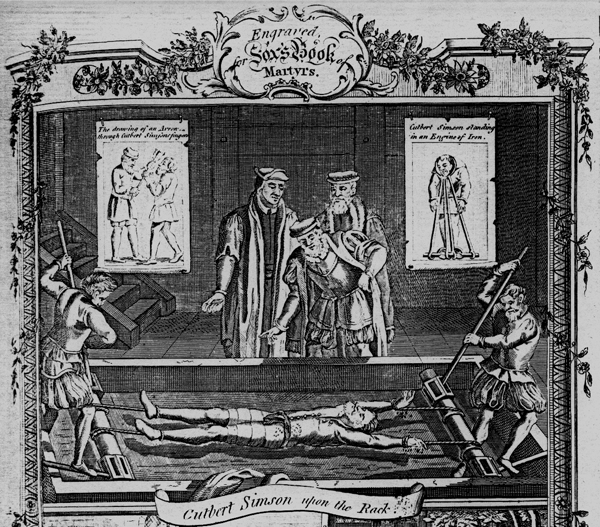 Cuthbert Symson
Few professors of Christ possessed more activity and zeal than this excellent person. He not only labored to preserve his friends from the contagion of popery, but he labored to guard them against the terrors of persecution. He was deacon of the little congregation over which Mr. Rough presided as minister.
Mr. Symson has written an account of his own sufferings, which he cannot detail better than in his own words:
"On the thirteenth of December, 1557, I was committed by the Council to the Tower of London. On the following Thursday, I was called into the ward-room, before the constable of the Tower, and the recorder of London, Mr. Cholmly, who commanded me to inform them of the names of those who came to the English service. I answered that I would declare nothing; in consequence of my refusal, I was set upon a rack of iron, as I judge for the space of three hours!
"They then asked me if I would confess: I answered as before.
After being unbound, I was carried back to my lodging. The Sunday after I was brought to the same place again, before the lieutenant and recorder of London, and they examined me. As I had answered before, so I answered now. Then the lieutenant swore by God I should tell; after which my two forefingers were bound together, and a small arrow placed between them, they drew it through so fast that the blood followed, and the arrow brake.
"After enduring the rack twice again, I was retaken to my lodging, and ten days after the lieutenant asked me if I would not now confess that which they had before asked of me. I answered, that I had already said as much as I would. Three weeks after I was sent to the priest, where I was greatly assaulted, and at whose hand I received the pope's curse, for bearing witness of the resurrection of Christ. And thus I commend you to God, and to the Word of His grace, with all those who unfeignedly call upon the name of Jesus; desiring God of His endless mercy, through the merits of His dear Son Jesus Christ, to bring us all to His everlasting Kingdom, Amen. I praise God for His great mercy shown upon us. Sing Hosanna to the Highest with me, Cuthbert Symson. God forgive my sins! I ask forgiveness of all the world, and I forgive all the world, and thus I leave the world, in the hope of a joyful resurrection!"
If this account be duly considered, what a picture of repeated tortures does it present! But even the cruelty of the narration is exceeded by the patient meekness with which it was endured. Here are no expressions of malice, no invocations even of God's retributive justice, not a complaint of suffering wrongfully! On the contrary, praise to God, forgiveness of sin, and a forgiving all the world, concludes this unaffected interesting narrative.
Bonner's admiration was excited by the steadfast coolness of this martyr. Speaking of Mr. Symson in the consistory, he said, "You see what a personable man he is, and then of his patience, I affirm, that, if he were not a heretic, he is a man of the greatest patience that ever came before me. Thrice in one day has he been racked in the Tower; in my house also he has felt sorrow, and yet never have I seen his patience broken."
The day before this pious deacon was to be condemned, while in the stocks in the bishop's coal-house, he had the vision of a glorified form, which much encouraged him. This he certainly attested to his wife, to Mr. Austen, and others, before his death.
With this ornament of the Christian Reformation were apprehended Mr. Hugh Foxe and John Devinish; the three were brought before Bonner, March 19, 1558, and the papistical articles tendered. They rejected them, and were all condemned. As they worshipped together in the same society, at Islington, so they suffered together in Smithfield, March 28; in whose death the God of Grace was glorified, and true believers confirmed!
Were condemned by a bigoted vicar of Aylesbury, named Berry.
The spot of execution was called Lollard's Pit, without Bishipsgate, at Norwich. After joining together in humble petition to the throne of grace, they rose, went to the stake, and were encircled with their chains. To the great surprise of the spectators, Hudson slipped from under his chains, and came forward. A great opinion prevailed that he was about to recant; others thought that he wanted further time. In the meantime, his companions at the stake urged every promise and exhortation to support him. The hopes of the enemies of the cross, however, were disappointed: the good man, far from fearing the smallest personal terror at the approaching pangs of death, was only alarmed thathis Savior's face seemed to be hidden from him. Falling upon his knees, his spirit wrestled with God, and God verified the words of His Son, "Ask, and it shall be given." The martyr rose in an ecstasy of joy, and exclaimed, "Now, I thank God, I am strong! and care not what man can do to me!" With an unruffled countenance he replaced himself under the chain, joined his fellow-sufferers, and with them suffered death, to the comfort of the godly, and the confusion of Antichrist.
Berry, unsatiated with this demoniacal act, summoned up two hundred persons in the town of Aylesham, whom he compelled to kneel to the cross at Pentecost, and inflicted other punishments. He struck a poor man for a trifling word, with a flail, which proved fatal to the unoffending object. He also gave a woman named Alice Oxes, so heavy a blow with his fist, as she met him entering the hall when he was in an ill-humor, that she died with the violence. This priest was rich, and possessed great authority; he was a reprobate, and, like the priesthood, he abstained from marriage, to enjoy the more a debauched and licentious life. The Sunday after the death of Queen Mary, he was revelling with one of his concubines, before vespers; he then went to church, administered baptism, and in his return to his lascivious pastime, he was smitten by the hand of God. Without a moment given for repentance, he fell to the ground, and a groan was the only articulation permitted him. In him we may behold the difference between the end of a martyr and a persecutor.
In a retired close near a field, in Islington, a company of decent persons had assembled, to the number of forty. While they were religiously engaged in praying and expounding the Scripture, twenty-seven of them were carried before Sir Roger Cholmly. Some of the women made their escape, twenty-two were committed to Newgate, who continued in prison seven weeks. Previous to their examination, they were informed by the keeper, Alexander, that nothing more was requisite to procure their discharge, than to hear Mass. Easy as this condition may seem, these martyrs valued their purity of conscience more than loss of life or property; hence, thirteen were burnt, seven in Smithfield, and six at Brentford; two died in prison, and the other seven were providentially preserved. The names of the seven who suffered were, H. Pond, R. Estland, R. Southain, M. Ricarby, J. Floyd, J. Holiday, and Roger Holland. They were sent to Newgate, June 16, 1558, and executed on the twenty-seventh.
This Roger Holland, a merchant-tailor of London, was first an apprentice with one Master Kemption, at the Black Boy in Watling Street, giving himself to dancing, fencing, gaming, banqueting, and wanton company. He had received for his master certain money, to the sum of thirty pounds; and lost every groat at dice. Therefore he purposed to convey himself away beyond the seas, either into France or into Flanders.
With this resolution, he called early in the morning on a discreet servant in the house, named Elizabeth, who professed the Gospel, and lived a life that did honor to her profession. To her he revealed the loss his folly had occasioned, regretted that he had not followed her advice, and begged her to give his master a note of hand from him acknowledging the debt, which he would repay if ever it were in his power; he also entreated his disgraceful conduct might be kept secret, lest it would bring the gray hairs to his father with sorrow to a premature grave.
The maid, with a generosity and Christian principle rarely surpassed, conscious that his imprudence might be his ruin, brought him the thirty pounds, which was part of a sum of money recently left her by legacy. "Here," said she, "is the sum requisite: you shall take the money, and I will keep the note; but expressly on this condition, that you abandon all lewd and vicious company; that you neither swear nor talk immodestly, and game no more; for, should I learn that you do, I will immediately show this note to your master. I also require, that you shall promise me to attend the daily lecture at Allhallows, and the sermon at St. Paul's every Sunday; that you cast away all your books of popery, and in their place substitute the Testament and the Book of Service, and that you read the Scriptures with reverence and fear, calling upon God for his grace to direct you in his truth. Pray also fervently to God, to pardon your former offences, and not to remember the sins of your youth, and would you obtain his favor ever dread to break his laws or offend his majesty. So shall God have you in His keeping, and grant you your heart's desire." We must honor the memory of this excellent domestic, whose pious endeavors were equally directed to benefit the thoughtless youth in this life and that which is to come. God did not suffer the wish of this excellent domestic to be thrown upon a barren soil; within half a year after the licentious Holland became a zealous professor of the Gospel, and was an instrument of conversion to his father and others whom he visited in Lancashire, to their spiritual comfort and reformation from popery.
His father, pleased with his change of conduct, gave him forty pounds to commence business with in London.
Then Roger repaired to London again, and came to the maid that lent him the money to pay his master withal, and said unto her, "Elizabeth, here is thy money I borrowed of thee; and for the friendship, good will, and the good counsel I have received at thy hands, to recompense thee I am not able, otherwise than to make thee my wife." And soon after they were married, which was in the first year of Queen Mary.
After this he remained in the congregations of the faithful, until, the last year of Queen Mary, he, with the six others aforesaid, were taken.
And after Roger Holland there was none suffered in Smithfield for the testimony of the Gospel, God be thanked.
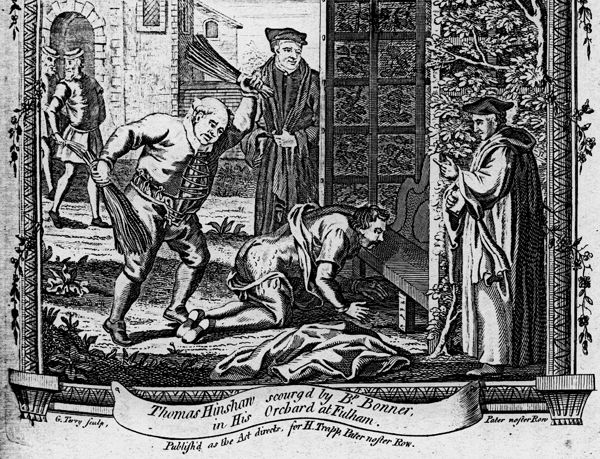 Flagellations by Bonner
When this Catholic hyena found that neither persuasions, threats, nor imprisonment, could produce any alteration in the mind of a youth named Thomas Hinshaw, he sent him to Fulham, and during the first night set him in the stocks, with no other allowance than bread and water. The following morning he came to see if this punishment had worked any change in his mind, and finding none, he sent Dr. Harpsfield, his archdeacon, to converse with him. The doctor was soon out f humor at his replies, called him peevish boy, and asked him if he thought he went about to damn his soul? "I am persuaded," said Thomas, "that you labor to promote the dark kingdom of the devil, not for the love of the truth." These words the doctor conveyed to the bishop, who, in a passion that almost prevented articulation, came to Thomas, and said, "Dost thou answer my archdeacon thus, thou naughty boy? But I'll soon handle thee well enough for it, be assured!" Two willow twigs were then brought him, and causing the unresisting youth to kneel against a long bench, in an arbor in his garden, he scourged him until he was compelled to cease for want of breath and fatigue. One of the rods was worn quite away.
Many other conflicts did Hinsaw undergo from the bishop; who, at length, to remove him effectually, procured false witnesses to lay articles against him, all of which the young man denied, and, in short, refused to answer any interrogatories administered to him. A fortnight after this, the young man was attacked by a burning ague, and at the request of his master. Mr. Pugson, of St. Paul's church-yard, he was removed, the bishop not doubting that he had given him his death in the natural way; he however remained ill above a year, and in the mean time Queen Mary died, by which act of providence he escaped Bonner's rage.
John Willes was another faithful person, on whom the scourging hand of Bonner fell. He was the brother of Richard Willes, before mentioned, burnt at Brentford. Hinshaw and Willes were confined in Bonner's coal house together, and afterward removed to Fulham, where he and Hinshaw remained during eight or ten days, in the stocks. Bonner's persecuting spirit betrayed itself in his treatment of Willes during his examinations, often striking him on the head with a stick, seizing him by the ears, and filliping him under the chin, saying he held down his head like a thief. This producing no signs of recantation, he took him into his orchard, and in a small arbor there he flogged him first with a willow rod, and then with birch, until he was exhausted. This cruel ferocity arose from the answer of the poor sufferer, who, upon being asked how long it was since he had crept to the cross, replied, 'Not since he had come to years of discretion, nor would he, though he should be torn to pieces by wild horses.' Bonner then bade him make the sign of the cross on his forehead, which he refused to do, and thus was led to the orchard.
One day, when in the stocks, Bonner asked him how he liked his lodging and fare. "Well enough," said Willes, "might I have a little straw to sit or lie upon." Just at this time came in Willes' wife, then largely pregnant, and entreated the bishop for her husband, boldly declaring that she would be delivered in the house, if he were not suffered to go with her. To get rid of the good wife's importunity, and the trouble of a lying-in woman in his palace, he bade Willes make the sign of the cross, and say, In nomine Patris, et Filii, et Spiritus Sancti, Amen. Willes omitted the sign, and repeated the words, "in the name of the Father, and of the Son, and of the Holy Ghost, Amen." Bonner would have the words repeated in Latin, to which Willes made no objection, knowing the meaning of the words. He was then permitted to go home with his wife, his kinsman Robert Rouze being charged to bring him to St. Paul's the next day, whither he himself went, and subscribing to a Latin instrument of little importance, was liberated. This is the last of the twenty-two taken at Islington.
This devout aged person was curate to Dr. Taylor, at Hadley, and eminently qualified for his sacred function. Dr. Taylor left him the curacy at his departure, but no sooner had Mr. Newall gotten the benefice, than he removed Mr. Yeoman, and substituted a Romish priest. After this he wandered from place to place, exhorting all men to stand faithfully to God's Word, earnestly to give themselves unto prayer, with patience to bear the cross now laid upon them for their trial, with boldness to confess the truth before their adversaries, and with an undoubted hope to wait for the crown and reward of eternal felicity. But when he perceived his adversaries lay wait for him, he went into Kent, and with a little packet of laces, pins, points, etc., he travelled from village to village, selling such things, and in this manner subsisted himself, his wife, and children.
At last Justice Moile, of Kent, took Mr. Yeoman, and set him in the stocks a day and a night; but, having no evident matter to charge him with, he let him go again. Coming secretly again to Hadley, he tarried with his poor wife, who kept him privately, in a chamber of the town house, commonly called the Guildhall, more than a year. During this time the good old father abode in a chamber locked up all the day, spending his time in devout prayer, in reading the Scriptures, and in carding the wool which his wife spun. His wife also begged bread for herself and her children, by which precarious means they supported themselves. Thus the saints of God sustained hunger and misery, while the prophets of Baal lived in festivity, and were costily pampered at Jezebel's table.
Information being at length given to Newall, that Yeoman was secreted by his wife, he came, attended by the constables, and broke into the room where the object of his search lay in bed with his wife. He reproached the poor woman with being a whore, and would have indecently pulled the clothes off, but Yeoman resisted both this act of violence and the attack upon his wife's character, adding that he defied the pope and popery. He was then taken out, and set in stocks until day.
In the cage also with him was an old man, named John Dale, who had sat there three or four days, for exhorting the people during the time service was performing by Newall and his curate. His words were, "O miserable and blind guides, will ye ever be blind leaders of the blind? Will ye never amend? Will ye never see the truth of God's Word? Will neither God's threats nor promises enter into your hearts? Will the blood of the martyrs nothing mollify your stony stomachs? O obdurate, hard-hearted, perverse, and crooked generation! to whom nothing can do good."
These words he spake in fervency of spirit agains tthe superstitious religion of Rome; wherefore Newall caused him forthwith to be attached, and set in the stocks in a cage, where he was kept until Sir Henry Doile, a justice, came to Hadley.
When Yeoman was taken, the parson called earnestly upon Sir Henry Doile to send them both to prison. Sir Henry Doile as earnestly entreated the parson to consider the age of the men, and their mean condition; they were neither persons of note nor preachers; wherefore he proposed to let them be punished a day or two and to dismiss them, at least John Dale, who was no priest, and therefore, as he had so long sat in the cage, he thought it punishment enough for this time. When the parson heard this, he was exceedingly mad, and in a great rage called them pestilent heretics, unfit to live in the commonwealth of Christians.
Sir Henry, fearing to appear too merciful, Yeoman and Dale were pinioned, bound like thieves with their legs under the horses' bellies, and carried to Bury jail, where they were laid in irons; and because they continually rebuked popery, they were carried into the lowest dungeon, where John Dale, through the jail-sickness and evil-keeping, died soon after: his body was thrown out, and buried in the fields. He was a man of sixty-six years of age, a weaver by occupation, well learned in the holy Scriptures, steadfast in his confession of the true doctrines of Christ as set forth in King Edward's time; for which he joyfully suffered prison and chains, and from this worldly dungeon he departed in Christ to eternal glory, and the blessed paradise of everlasting felicity.
After Dale's death, Yeoman was removed to Norwich prison, where, after strait and evil keeping, he was examined upon his faith and religion, and required to submit himself to his holy father the pope. "I defy him, (quoth he), and all his detestable abomination: I will in no wise have to do with him." The chief articles objected to him, were his marriage and the Mass sacrifice. Finding he continued steadfast in the truth, he was condemned, degraded, and not only burnt, but most cruelly tormented in the fire. Thus he ended this poor and miserable life, and entered into that blessed bosom of Abraham, enjoying with Lazarus that rest which God has prepared for His elect.
Mr. Benbridge was a single gentleman, in the diocese of Winchester. He might have lived a gentleman's life, in the wealthy possessions of this world; but he chose rather to enter through the strait gate of persecution to the heavenly possession of life in the Lord's Kingdom, than to enjoy present pleasure with disquietude of conscience. Manfully standing against the papists for the defence of the sincere doctrine of Christ's Gospel, he was apprehended as an adversary to the Romish religion, and led for examination before the bishop of Winchester, where he underwent several conflicts for the truth against the bishop and his colleague; for which he was condemned, and some time after brought to the place of martyrdom by Sir Richard Pecksal, sheriff.
When standing at the stake he began to untie his points, and to prepare himself; then he gave his gown to the keeper, by way of fee. His jerkin was trimmed with gold lace, which he gave to Sir Richard Pecksal, the high sheriff. His cap of velvet he took from his head, and threw away. Then, lifting his mind to the Lord, he engaged in prayer.
When fastened to the stake, Dr. Seaton begged him to recant, and he should have his pardon; but when he saw that nothing availed, he told the people not to pray for him unless he would recant, no more than they would pray for a dog.
Mr. Benbridge, standing at the stake with his hands together in such a manner as the priest holds his hands in his Memento, Dr. Seaton came to him again, and exhorted him to recant, to whom he said, "Away, Babylon, away!" One that stood by said, "Sir, cut his tongue out"; another, a temporal man, railed at him worse than Dr. Seaton had done.
When they saw he would not yield, they bade the tormentors to light the pile, before he was in any way covered with fagots. The fire first took away a piece of his beard, at which he did not shrink. Then it came on the other side and took his legs, and the nether stockings of his hose being leather, they made the fire pierce the sharper, so that the intolerable heat made him exclaim, "I recant!" and suddenly he trust the fire from him. Two or three of his friends being by, wished to save him; they stepped to the fire to help remove it, for which kindness they were sent to jail. The sheriff also of his own authority took him from the stake, and remitted him to prison, for which he was sent to the Fleet, and lay there sometime. Before, however, he was taken from the stake, Dr. Seaton wrote articles for him to subscribe to. To these Mr. Benbridge made so many objections that Dr. Seaton ordered them to set fire again to the pile. Then with much pain and grief of heart he subscribed to them upon a man's back.
This done, his gown was given him again, and he was led to prison. While there, he wrote a letter to Dr. Seaton, recanting those words he had spoken at the stake, and the articles which he had subscribed, for he was grieved that he had ever signed them. The same day se'night he was again brought to the stake, where the vile tormentors rather broiled than burnt him. The Lord give his enemies repentance!
From the number condemned in this fanatical reign, it is almost impossible to obtain the name of every martyr, or to embellish the history of all with anecdotes and exemplifications of Christian conduct. Thanks be to Providence, our cruel task begins to draw towards a conclusion, with the end of the reign of papal terror and bloodshed. Monarchs, who sit upon thrones possessed by hereditary right, should, of all others, consider that the laws of nature are the laws of God, and hence that the first law of nature is the preservation of their subjects. Maxims of persecutions, of torture, and of death, they should leave to those who have effected sovereignty by fraud or by sword; but where, except among a few miscreant emperors of Rome, and the Roman pontiffs, shall we find one whose memory is so "damned to everlasting fame" as that of Queen Mary? Nations bewail the hour which separates them forever from a beloved governor, but, with respect to that of Mary, it was the most blessed time of her whole reign. Heaven has ordained three great scourges for national sins-plague, pestilence, and famine. It was the will of God in Mary's reign to bring a fourth upon this kingdom, under the form of papistical persecution. It was sharp, but glorious; the fire which consumed the martyrs has undermined the popedom; and the Catholic states, at present the most bigoted and unenlightened, are those which are sunk lowest in the scale of moral dignity and political consequence. May they remain so, until the pure light of the Gospel shall dissipate the darkness of fanaticism and superstition! But to return.
Mrs. Prest for some time lived about Cornwall, where she had a husband and children, whose bigotry compelled her to frequent the abominations of the Church of Rome. Resolving to act as her conscience dictated, she quitted them, and made a living by spinning. After some time, returning home, she was accused by her neighbors, and brought to Exeter, to be examined before Dr. Troubleville, and his chancellor Blackston. As this martyr was accounted of inferior intellect, we shall put her in competition with the bishop, and let the reader judge which had the most of that knowledge conducive to everlasting life. The bishop bringing the question to issue, respecting the bread and wine being flesh and blood, Mrs. Prest said, "I will demand of you whether you can deny your creed, which says, that Christ doth perpetually sit at the right hand of His Father, both body and soul, until He come again; or whether He be there in heaven our Advocate, and to make prayer for us unto God His Father? If He be so, He is not here on earth in a piece of bread. If He be not here, and if He do not dwell in temples made with hands, but in heaven, what! shall we seek Him here? If He did not offer His body once for all, why make you a new offering? If with one offering He made all perfect, why do you with a false offering make all imperfect? If He be to be worshipped in spirit and in truth, why do you worship a piece of bread? If He be eaten and drunken in faith and truth, if His flesh be not profitable to be among us, why do you say you make His flesh and blood, and say it is profitable for body and soul? Alas! I am a poor woman, but rather than to do as you do, I would live no longer. I have said, Sir."
Bishop. I promise you, you are a jolly Protestant. I pray you in what school have you been brought up?
Mrs. Prest. I have upon the Sundays visited the sermons, and there have I learned such things as are so fixed in my breast, that death shall not separate them.
B. O foolish woman, who will waste his breath upon thee, or such as thou art? But how chanceth it that thou wentest away from thy husband? If thou wert an honest woman, thou wouldst not have left thy husband and children, and run about the country like a fugitive.
Mrs. P. Sir, I labored for my livingl; and as my Master Christ counselleth me, when I was persecuted in one city, I fled into another.
B. Who persecuted thee?
Mrs. P. My husband and my children. For when I would have them to leave idolatry, and to worship God in heaven, he would not hear me, but he with his children rebuked me, and troubled me. I fled not for whoredom, nor for theft, but because I would be no partaker with him and his of that foul idol the Mass; and wheresoever I was, as oft as I could, upon Sundays and holydays. I made excuses not to go to the popish Church.
B. Belike then you are a good housewife, to fly from your husband the Church.
Mrs. P. My housewifery is but small; but God gave me grace to go to the true Church.
B. The true Church, what dost thou mean?
Mrs. P. Not your popish Church, full of idols and abominations, but where two or three are gathered together in the name of God, to that Church will I go as long as I live.
B. Belike then you have a church of your own. Well, let this mad woman be put down to prison until we send for her husband.
Mrs. P. No, I have but one husband, who is here already in this city, and in prison with me, from whom I will never depart.
Some persons present endeavoring to convince the bishop she was not in her right senses, she was permitted to depart. The keeper of the bishop's prisons took her into his house, where she either spun worked as a servant, or walked about the city, discoursing upon the Sacrament of the altar. Her husband was sent for to take her home, but this she refused while the cause of religion could be served. She was too active to be idle, and her conversation, simple as they affected to think her, excited the attention of several Catholic priests and friars. They teased her with questions, until she answered them angrily, and this excited a laugh at her warmth.
"Nay," said she, "you have more need to weep than to laugh, and to be sorry that ever you were born, to be the chaplains of that whore of Babylon. I defy him and all his falsehood; and get you away from me, you do but trouble my conscience. You would have me follow your doings; I will first lose my life. I pray you depart."
"Why, thou foolish woman," said they, "we come to thee for thy profit and soul's health." To which she replied, "What profit ariseth by you, that teach nothing but lies for truth? how save you souls, when you preach nothing but lies, and destroy souls?"
"How provest thou that?" said they.
"Do you not destroy your souls, when you teach the people to worship idols, stocks, and stones, the works of men's hands? and to worship a false God of your own making of a piece of bread, and teach that the pope is God's vicar, and hath power to forgive sins? and that there is a purgatory, when God's Son hath by His passion purged all? and say you make God and sacrifice Him, when Christ's body was a sacrifice once for all? Do you not teach the people to number their sins in your ears, and say they will be damned if they confess not all; when God's Word saith, Who can number his sins? Do you not promise them trentals and dirges and Masses for souls, and sell your prayers for money, and make them buy pardons, and trust to such foolish inventions of your imaginations? Do you not altogether act against God? Do you not teach us to pray upon beads, and to pray unto saints, and say they can pray for us? Do you not make holy water and holy bread to fray devils? Do you not do a thousand more abominations? And yet you say, you come for my profit, and to save my soul. No, no, one hath saved me. Farewell, you with your salvation."
During the liberty granted her by the bishop, before-mentioned, she went into St. Peter's Church, and there found a skilful Dutchman, who was affixing new noses to certain fine images which had been disfigured in King Edward's time; to whom she said, "What a madman art thou, to make them new noses, which within a few days shall all lose their heads?" The Dutchman accused her and laid it hard to her charge. And she said unto him, "Thou art accursed, and so are thy images." He called her a whore. "Nay," said she, "thy images are whores, and thou art a whore-hunter; for doth not God say, 'You go a whoring after strange gods, figures of your own making? and thou art one of them.'" After this she was ordered to be confined, and had no more liberty.
During the time of her imprisonment, many visited her, some sent by the bishop, and some of their own will, among these was one Daniel, a great preacher of the Gospel, in the days of King Edward, about Cornwall and Devonshire, but who, through the grievous persecution he had sustained, had fallen off. Earnestly did she exhort him to repent with Peter, and to be more constant in his profession.
Mrs. Walter Rauley and Mr. William and John Kede, persons of great respectability, bore ample testimony of her godly conversation, declaring, that unless God were with her, it were impossible she could have so ably defended the cause of Christ. Indeed, to sum up the character of this poor woman, she united the serpent and the dove, abounding in the highest wisdom joined to the greatest simplicity. She endured imprisonment, threatenings, taunts, and the vilest epithets, but nothing could induce her to swerve; her heart was fixed; she had cast anchor; nor could all the wounds of persecution remove her from the rock on which her hopes of felicity were built.
Such was her memory, that, without learning, she could tell in what chapter any text of Scripture was contained: on account of this singular property, one Gregory Basset, a rank papist, said she was deranged, and talked as a parrot, wild without meaning. At length, having tried every manner without effect to make her nominally a Catholic, they condemned her. After this, one exhorted her to leave her opinions, and go home to her family, as she was poor and illiterate. "True, (said she) though I am not learned, I am content to be a witness of Christ's death, and I pray you make no longer delay with me; for my heart is fixed, and I will never say otherwise, nor turn to your superstitious doing."
To the disgrace of Mr. Blackston, treasurer of the church, he would often send for this poor martyr from prison, to make sport for him and a woman whom he kept; putting religious questions to her, and turning her answers into ridicule. This done, he sent her back to her wretched dungeon, while he battened upon the good things of this world.
There was perhaps something simply ludicrous in the form of Mrs. Prest, as she was of a very short stature, thick set, and about fifty-four years of age; but her countenance was cheerful and lively, as if prepared for the day of her marriage with the Lamb. To mock at her form was an indirect accusation of her Creator, who framed her after the fashion He liked best, and gave her a mind that far excelled the transient endowments of perishable flesh. When she was offered money, she rejected it, "because (said she) I am going to a city where money bears no mastery, and while I am here God has promised to feed me."
When sentence was read, condemning her to the flames, she lifted up her voice and praised God, adding, "This day have I found that which I have long sought." When they tempted her to recant, "That will I not, (said she) God forbid that I should lose the life eternal, for this carnal and short life. I will never turn from my heavenly husband to my earthly husband; from the fellowship of angels to mortal children; and if my husband and children be faithful, then am I theirs. God is my father, God is my mother, God is my sister, my brother, my kinsman; God is my friend, most faithful."
Being delivered to the sheriff, she was led by the officer to the place of execution, without the walls of Exeter, called Sothenhey, where again the superstitious priests assaulted her. While they were tying her to the stake, she continued earnestly to exclaim "God be merciful to me, a sinner!" Patiently enduring the devouring conflagration, she was consumed to ashes, and thus ended a life which in unshaken fidelity to the cause of Christ, was not surpassed by that of any preceding martyr.
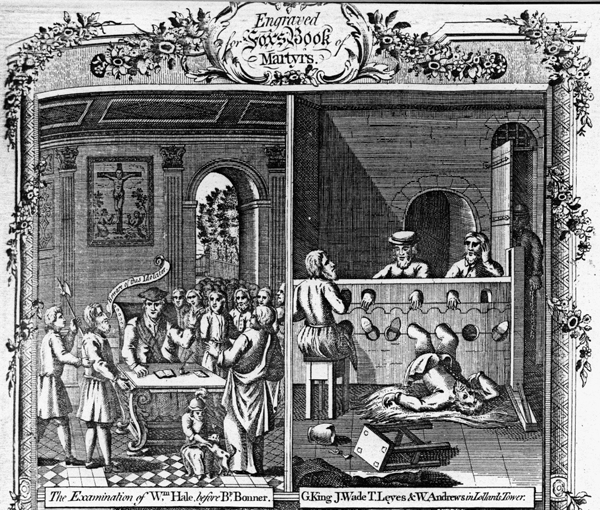 Richard Sharpe, Thomas Banion, and Thomas Hale
Mr. Sharpe, weaver, of Bristol, was brought the ninth day of March, 1556, before Dr. Dalby, chancellor of the city of Bristol, and after examination concerning the Sacrament of the altar, was persuaded to recant; and on the twenty-ninth, he was enjoined to make his recantation in the parish church. But, scarcely had he publicly avowed his backsliding, before he felt in his conscience such a tormenting fiend, that he was unable to work at his occupation; hence, shortly after, one Sunday, he came into the parish church, called Temple, and after high Mass, stood up in the choir door, and said with a loud voice, "Neighbors, bear me record that yonder idol (pointing to the altar) is the greatest and most abominable that ever was; and I am sorry that ever I denied my Lord God!" Notwithstanding the constables were ordered to apprehend him, he was suffered to go out of the church; but at night he was apprehended and carried to Newgate. Shortly after, before the chancellor, denying the Sacrament of the altar to be the body and blood of Christ, he was condemned to be burned by Mr. Dalby. He was burnt the seventh of May, 1558, and died godly, patiently, and constantly, confessing the Protestant articles of faith.With him suffered Thomas Hale, shoemaker, of Bristol, who was condemned by Chcnallor Dalby. These martyrs were bound back to back.
Thomas Banion, a weaver, was burnt on August 27, of the same year, and died for the sake of the evangelical cause of his Savior.
With pleasure we have to record that these five martyrs were the last who suffered in the reign of Mary for the sake of the Protestant cause; but the malice of the papists was conspicuous in hastening their martyrdom, which might have been delayed until the event of the queen's illness was decided. It is reported that the archdeacon of Canterbury, judging that the sudden death of the queen would suspend the execution, travelled post from London, to have the satisfaction of adding another page to the black list of papistical sacrifices.
The articles against them were, as usual, the Sacramental elements and the idolatry of bending to images. They quoted St. John's words, "Beware of images!" and respecting the real presence, they urged according to St. Paul, "the things which are seen are temporal." When sentence was about to be read against them, and excommunication to take place in the regular form, John Corneford, illuminated by the Holy Spirit, awfully turned the latter proceeding against themselves, and in a solemn impressive manner, recriminated their excommunication in the following words: "In the name of our Lord Jesus Christ, the Son of the most mighty God, and by the power of His Holy Spirit, and the authority of His holy Catholic and apostolic Church, we do here give into the hands of Satan to be destroyed, the bodies of all those blasphemers and heretics that maintain any error against His most holy Word, or do condemn His most holy truth for heresy, to the maintenance of any false church or foreign religion, so that by this Thy just judgment, O most mighty God, against Thy adversaries, Thy true religion may be known to Thy great glory and our comfort and to the edifying of all our nation. Good Lord, so be it. Amen."
This sentence was openly pronounced and registered, and, as if Providence had awarded that it should not be delivered in vain, within six days after, Queen Mary died, detested by all good men and accursed of God!
Though acquainted with these circumstances, the archdeacon's implacability exceeded that of his great exemplary, Bonner, who, though he had several persons at that time under his fiery grasp, did not urge their deaths hastily, by which delay he certainly afforded them an opportunity of escape. At the queen's decease, many were in bonds: some just taken, some examined, and others condemned. The writs indeed were issued for several burnings, but by the death of the three instigators of Protestant murder-the chancellor, the bishop, and the queen, who fell nearly together, the condemned sheep were liberated, and lived many years to praise God for their happy deliverance.
These five martyrs, when at the stake, earnestly prayed that their blood might be the last shed, nor did they pray in vain. They died gloriously, and perfected the number God had selected to bear witness of the truth in this dreadful reign, whose names are recorded in the Book of Life; though last, not least among the saints made meet for immortality through the redeeming blood of the Lamb!
Catharine Finlay, alias Knight, was first converted by her son's expounding the Scriptures to her, which wrought in her a perfect work that terminated in martyrdom. Alice Snoth at the stake sent for her grandmother and godfather, and rehearsed to them the articles of her faith, and the Commandments of God, thereby convincing the world that she knew her duty. She died calling upon the spectators to bear witness that she was a Christian woman, and suffered joyfully for the testimony of Christ's Gospel.
Among the numberless enormities committed by the merciless and uhnfeeling Bonner, the murder of this innocent and unoffending child may be ranged as the most horrid. His father, John Fetty, of the parish of Clerkenwell, by trade a tailor, and only twenty-four years of age, had made blessed election; he was fixed secure in eternal hope, and depended on Him who so builds His Church that the gates of hell shall not prevail against it. But alas! the very wife of his bosom, whose heart was hardened against the truth, and whose mind was influenced by the teachers of false doctrine, became his accuser. Brokenbery, a creature of the pope, and parson of the parish, received the information of this wedded Delilah, in consequence of which the poor man was apprehended. But here the awful judgment of an ever-righteous God, who is "of purer eyes than to behold evil," fell upon this stone-hearted and perfidious woman; for no sooner was the injured husband captured by her wicked contriving, than she also was suddenly seized with madness, and exhibited an awful and awakening instance of God's power to punish the evil-doer. This dreadful circumstance had some effect upon the hearts of the ungodly hunters who had eagerly grasped their prey; but, in a relenting moment, they suffered him to remain with his unworthy wife, to return her good for evil, and to comfort two children, who, on his being sent to prison, would have been left without a protector, or have become a burden to the parish. As bad men act from little motives, we may place the indulgence shown him to the latter account.
We have noticed in the former part of our narratives of the martyrs, some whose affection would have led them even to sacrifice their own lives, to preserve their husbands; but here, agreeable to Scripture language, a mother proves, indeed, a monster in nature! Neither conjugal nor maternal affection could impress the heart of this disgraceful woman.
Although our afflicted Christian had experienced so much cruelty and falsehood from the woman who was bound to him by every tie both human and divine, yet, with a mild and forbearing spirit, he overlooked her misdeeds, during her calamity endeavoring all he could to procure relief for her malady, and soothing her by every possible expression of tenderness: thus she became in a few weeks nearly restored to her senses. But, alas! she returned again to her sin, "as a dog returneth to his vomit." Malice against the saints of the Most High was seated in her heart too firmly to be removed; and as her strength returned, her inclination to work wickedness returned with it. Her heart was hardened by the prince of darkness; and to her may be applied these afflicting and soul-harrowing words, "Can the Ethiopian change his skin, or the leopard his spots? then may ye also do good, that are accustomed to do evil." Weighing this text duly with another, "I will have mercy on whom I will have mercy," how shall we presume to refine away the sovereignty of God by arrainging Jehovah at the bar of human reason, which, in religious matters, is too often opposed by infinite wisdom? "Broad is the way, that leadeth to destruction, and many there be which go in thereat. Narrow is the way, which leadeth unto life, and few there be that find it." The ways of heaven are indeed inscrutable, and it is our bounden duty to walk ever dependent on God, looking up to Him with humble confidence, and hope in His goodness, and ever confess His justice; and where we "cannot unravel, there learn to trust." This wretched woman, pursuing the horrid dictates of a heart hardened and depraved, was scarcely confirmed in her recovery, when, stifling the dictates of honor, gratitude, and every natural affection, she again accused her husband, who was once more apprehended, and taken before Sir John Mordant, knight, and one of Queen Mary's commissioners.
Upon examination, his judge finding him fixed in opinions which militated against those nursed by superstition and maintained by cruelty, he was sentenced to confinement and torture in Lollard's Tower. Here he was put into the painful stocks, and had a dish of water set by him, with a stone put into it, to what purpose God knoweth,e xcept it were to show that he should look for little other subsistence: which is credible enough, if we consider their like practices upon divers before mentioned in this history; as, among others, upon Richard Smith, who died through their cruel imprisonment touching whom, when a godly woman came to Dr. Story to have leave she might bury him, he asked her if he had any straw or blood in his mouth; but what he means thereby, I leave to the judgment of the wise.
On the first day of the third week of our martyr's sufferings, an object presented itself to his view, which made him indeed feel his tortures with all their force, and to execrate, with bitterness only short of cursing, the author of his misery. To mark and punish the proceedings of his tormentors, remained with the Most High, who noteth even the fall of a sparrow, and in whose sacred Word it is written, "Vengeance is mine; I will repay." This object was his own son, a child of the tender age of eight years. For fifteen days, had its hapless father been suspended by his tormentor by the right arm and left leg, and sometimes by both, shifting his positions for the purpose of giving him strength to bear and to lengthen the date of his sufferings. When the unoffending innocent, desirous of seeing and speaking to its parent, applied to Bonner for permission to do so, the poor child being asked by the bishop's chaplain the purport of his errand, he replied he wished to see his father. "Who is thy father?" said the chaplain. "John Fetty," returned the boy, at the same time pointing to the place where he was confined. The interrogating miscreant on this said, "Why, thy father is a heretic!" The little champion again rejoined, with energy sufficient to raise admiration in any breast, except that of this unprincipled and unfeeling wretch-this miscreant, eager to execute the behests of a remoseless queen-"My father is no heretic: for you have Balaam's mark."
Irritated by reproach so aptly applied, the indignant and mortified priest concealed his resentment for a moment, and took the undaunted boy into the house, where having him secure, he presented him to others, whose baseness and cruelty being equal to his own, they stripped him to the skin, and applied their scourges to so violent a degree, that, fainting beneath the stripes inflicted on his tender frame, and covered with the blood that flowed from them, the victim of their ungodly wrath was ready to expire under his heavy and unmerited punishment.
In this bleeding and helpless state was the suffering infant, covered only with his shirt, taken to his father by one of the actors in the horrid tragedy, who, while he exhibited the heart-rending spectacle, made use of the vilest taunts, and exulted in what he had done. The dutiful child, as if recovering strength at the sight of his father, on his knees implored his blessing. "Alas! Will," said the afflicted parent, in trembling amazement, "who hath done this to thee!" the artless innocent related the circumstances that led to the merciless correction which had been so basely inflicted on him; but when he repeated the reproof bestowed on the chaplain, and which was prompted by an undaunted spirit, he was torn from his weeping parent, and conveyed again to the house, where he remained a close prisoner.
Bonner, somewhat fearful that what had been done could not be justified even among the bloodhounds of his own voracious pack, concluded in his dark and wicked mind, to release John Fetty, for a time at least, from the severities he was enduring in the glorious cause of everlasting truth! whose bright rewards are fixed beyond the boundaries of time, within the confines of eternity; where the arrow of the wicked cannot wound, even "where there shall be no more sorrowing for the blessed, who, in the mansion of eternal bliss shall glorify the Lamb forever and ever." He was accordingly by order of Bonner, (how disgraceful to all dignity, to say bishop!) liberated from the painful bonds, and led from Lollard's Tower, to the chamber of that ungodly and infamous butcher, where he found the bishop bathing himself before a great fire; and at his first entering the chamber, Fetty said, "God be here and peace!" "God be here and peace, (said Bonner,) that is neither God speed nor good morrow!" "If ye kick against this peace, (said Fetty), then this is not the place that I seek for."
A chaplain of the bishop, standing by, turned the poor man about, and thinking to abash him, said, in mocking wise, "What have we here-a player!" While Fetty was thus standing in the bishop's chamber, he espied, hanging about the bishop's bed, a pair of great black beads, whereupon he said, "My Lord, I think the hangman is not far off: for the halter (pointing to the beads) is here already!" At which words the bishop was in a marvellous rage. Then he immediately after espied also, standing in the bishop's chamber, in the window, a little crucifix. Then he asked the bishop what it was, and he answered, that it was Christ. "Was He handled as cruelly as He is here pictured!" said Fetty. "Yea, that He was," said the bishop. "And even so cruelly will you handle such as come before you; for you are unto God's people as Caiaphas was unto Christ!" The bishop, being in a great fury, said, "Thou art a vile heretic, and I will burn thee, or else I will spend all I have, unto my gown." "Nay, my Lord, (said Fetty) you were better to give it to some poor body, that he may pray for you." Bonner, notwithstanding his passion, which was raised to the utmost by the calm and pointed remarks of this observing Christian, thought it most prudent to dismiss the father, on account of the nearly murdered child. His coward soul trembled for the consequences which might ensue; fear is inseparable from little minds; and this dastardly pampered priest experienced its effects so far as to induce him to assume the appearance of that he was an utter stranger to, namely, MERCY.
The father, on being dismissed, by the tyrant Bonner, went home with a heavy heart, with his dying child, who did not survive many days the cruelties which had been inflicted on him.
How contrary to the will of our great King and Prophet, who mildly taught His followers, was the conduct of this sanguinary and false teacher, this vile apostate from his God to Satan! But the archfiend had taken entire possession of his heart, and guided every action of the sinner he had hardened; who, given up to terrible destruction, was running the race of the wicked, marking his footsteps with the blood of the saints, as if eager to arrive at the goal of eternal death.
This eminent prelate, vice-chancellor of Cambridge, at the request of the duke of Northumberland, when he came down to Cambridge in support of Lady Jane Grey's claim to the throne, undertook at a few hours' notice, to preach before the duke and the university. The text he took was such as presented itself in opening the Bible, and a more appropriate one he could not have chosen, namely, the three last verses of Joshua. As God gave him the text, so He gave him also such order and utterance that it excited the most lively emotions in his numerous auditors. The sermon was about to be sent to London to be printed, when news arrived that the duke had returned and Queen Mary was proclaimed.
The duke was immediately arrested, and Dr. Sands was compelled by the university to give up his office. He was arrested by the queen's order, and when Mr. Mildmay wondered that so learned a man could wilfully incur danger, and speak against so good a princess as Mary, the doctor replied, "If I would do as Mr. Mildmay has done, I need not fear bonds. He came down armed against Queen Mary; before a trator-now a great friend. I cannot with one mouth blow hot and cold in this manner." A general plunder of Dr. Sands' property ensued, and he was brought to London upon a wretched horse. Various insults he met on the way from the bigoted Catholics, and as he passed through Bishopsgate-street, a stone struck him to the ground. He was the first prisoner that entered the Tower, in that day, on a religious account; his man was admitted with his Bible, but his shirts and other articles were taken from him.
On Mary's coronation day the doors of the dungeon were so laxly guarded that it was easy to escape. A Mr. Mitchell, like a true friend, came to him, afforded him his own clothes as a disguise, and was willing to abide the consequence of being found in his place. This was a rare friendship: but he refused the offer; saying, "I know no cause why I should be in prison. To do thus were to make myself guilty. I will expect God's good will, yet do I think myself much obliged to you"; and so Mr. Mitchell departed.
With Doctor Sands was imprisoned Mr. Bradford; they were kept close in prison twenty-nine weeks. John Fowler, their keeper, was a perverse papist, yet, by often persuading him, at length he began to favor the Gospel, and was so persuaded in the true religion, that on a Sunday, when they had Mass in the chapel, Dr. Sands administered the Communion to Bradford and to Fowler. Thus Fowler was their son begotten in bonds. To make room for Wyat and his accomplices, Dr. Sands and nine other preachers were sent to the Marshalsea.
The keeper of the Marshalsea appointed to every preacher a man to lead him in the street; he caused them to go on before, and he and Dr. Sands followed conversing together. By this time popery began to be unsavory. After they had passed the bridge, the keeper said to Dr. Sands: "I perceive the vain people would set you forward to the fire. You are as vain as they, if you, being a young man, will stand in your own conceit, and prefer your own judgment before that of so many worthy prelates, ancient, learned, and grave men as be in this realm. If you do so, you shall find me a severe keeper, and one that utterly dislikes your religion." Dr. Sands answered, "I know my years to be young, and my learning but small; it is enough to know Christ crucified, and he hath learned nothing who seeth not the great blasphemy that is in popery. I will yield unto God, and not unto man; I have read in the Scriptures of many godly and couretous keepers: may God make you one! if not, I trust He will give me strength and patience to bear your hard usage." Then said the keeper, "Are you resolved to stand to your religion?" "Yes," quoth the doctor, "by God's grace!" "Truly," said the keeper, "I love you the better for it; I did but tempt you: what favor I can show you, you shall be assured of; and I shall think myself happy if I might die at the stake with you."
He was as good as his word, for he trusted the doctor to walk in the fields alone, where he met with Mr. Bradford, who was also a prisoner in the King's Bench, and had found the same favor from his keeper. At his request, he put Mr. Saunders in along with him, to be his bedfellow, and the Communion was administered to a great number of communicants.
When Wyat with his army came to Southwark, he offered to liberate all the imprisoned Protestants, but Dr. Sands and the rest of the preachers refused to accept freedom on such terms.
After Dr. Sands had been nine weeks prisoner in the Marshalsea, by the mediation of Sir Thomas Holcroft, knight marshal, he was set at liberty. Though Mr. Holcroft had the queen's warrant, the bishop commanded him not to set Dr. Sands at liberty, until he had taken sureties of two gentlemen with him, each one bound in œ500, that Dr. Sands should not depart out of the realm without license. Mr. Holcroft immediately after met with two gentlemen of the north, friends and cousins to Dr. Sands, who offered to be bound for him.
After dinner, the same day, Sir Thomas Holcroft sent for Dr.
Sands to his lodgings at Westminster, to communicate to him all he had done. Dr. Sands answered: "I give God thanks, who hath moved your heart to mind me so well, that I think myself most bound unto you. God shall requite you, nor shall I ever be found unthankful. But as you have dealt friendly with me, I will also deal plainly with you. I came a freeman into prison; I will not go forth a bondman. As I cannot benefit my friends, so will I not hurt them. And if I be set at liberty, I will not tarry six days in this realm, if I may get out. If therefore I may not get free forth, send me to the Marshalsea again, and there you shall be sure of me."
This answer Mr. Holcroft much disapproved of; but like a true friend he replied: "Seeing you cannot be altered, I will change my purpose, and yield unto you. Come of it what will, I will set you at liberty; and seeing you have a mind to go over sea, get you gone as quick as you can. One thing I require of you, that, while you are there, you write nothing to me hither, for this may undo me."
Dr. Sands having taken an affectionate farewell of him and his other friends in bonds, departed. He went by Winchester house, and there took boat, and came to a friend's house in London, called William Banks, and tarried there one night. The next night he went to another friend's house, and there he heard that strict search was making for him, by Gardiner's express order.
Dr. Sands now conveyed himself by night to one Mr. Berty's house, a stranger who was in the Marshalsea prison with him a while; he was a good Protestant and dwelt in Mark-lane. There he was six days, and then removed to one of his acquaintances in Cornhill; he caused his man Quinton to provide two geldings for him, resolved on the morrow to ride into Essex, to Mr. Sands, his father-in-law, where his wife was, which, after a narrow escape, he effected. He had not been theretwo hours, before Mr. Sands was told that two of the guards would that night apprehend Dr. Sands.
That night Dr. Sands was guided to an honest farmer's near the sea, where he tarried two days and two nights in a chamber without company. After that he removed to one James Mower's, a shipmaster, who dwelt at Milton-Shore, where he waited for a wind to Flanders. While he was there, James Mower brought to him forty or fifty mariners, to whom he gave an exhortation; they liked him so well that they promised to die rather than he should be apprehended.
The sixth of May, Sunday, the wind served. In taking leave of his hostess, who had been married eight years without having a child, he gave her a fine handkerchief and an old royal of gold, and said, "Be of good comfort; before that one whole year be past, God shall give you a child, a boy." This came to pass, for, that day twelve-month, wanting one day, God gave her a son.
Scarcely had he arrived at Antwerp, when he learned that King Philip had sent to apprehend him. He next flew to Augsburg, in Cleveland, where Dr. Sands tarried fourteen days, and then travelled towards Strassburg, where, after he had lived one year, his wife came to him. He was sick of a flux nine months, and had a child which died of the plague. His amiable wife at length fell into a consumption, and died in his arms. When his wife was dead, he went to Zurich, and there was in Peter Martyr's house for the space of five weeks.
As they sat at dinner one day, word was suddenly brought that Queen Mary was dead, and Dr. Sands was sent for by his friends at Strassburg, where he preached. Mr. Grindal and he came over to England, and arrived in London the same day that Queen Elizabeth was crowned. This faithful servant of Christ, under Queen Elizabeth, rose to the highest distinction in the Church, being successively bishop of Worcester, bishop of London, and archbishop of York.
The preservation of Princess Elizabeth may be reckoned a remarkable instance of the watchful eye which Christ had over His Church. The bigotry of Mary regarded not the ties of consanguinity, of natural affection, of national succession. Her mind, physically morose, was under the dominion of men who possessed not the milk of human kindness, and whose principles werre sanctioned and enjoined by the idolatrous tenets of the Romish pontiff. Could they have foreseen the short date of Mary's reign, they would have imbrued their hands in the Protestant blood of Elizabeth, and, as a sine qua non of the queen's salvation, have compelled her to bequeath the kingdom to some Catholic prince. The contest might have been attended with the horrors incidental to a religious civil war, and calamities might have been felt in England similar to those under Henry the Great in France, whom Queen Elizabeth assisted in opposing his priest-ridden Catholic subjects. As if Providence had the perpetual establishment of the Protestant faith in view, the difference of the duration of the two reigns is worthy of notice. Mary might have reigned many years in the course of nature, but the course of grace willed it otherwise. Five years and four months was the time of persecution alloted to this weak, disgraceful reign, while that of Elizabeth reckoned a number of years among the highest of those who have sat on the English throne, almost nine times that of her merciless sister!
Before Mary attained the crown, she treated Elizabeth with a sisterly kindness, but from that period her conduct was altered, and the most imperious distance substituted. Though Elizabeth had no concern in the rebellion of Sir Thomas Wyat, yet she was apprehended, and treated as a culprit in that commotion. The manner too of her arrest was similar to the mind that dictated it: the three cabinet members, whom she deputed to see the arrest executed, rudely entered the chamber at ten o'clock at night, and, though she was extremely ill, they could scarcely be induced to let her remain until the following morning. Her enfeebled state permitted her to be moved only by short stages in a journey of such length to London; but the princess, though afflicted in person, had a consolation in mind which her sister never could purchase: the people, through whom she passed on her way pitied her, and put up their prayers for her preservation.
Arrived at court, she was made a close prisoner for a fortnight, without knowing who was her accuser, or seeing anyone who could console or advise her. The charge, however, was at length unmasked by Gardiner, who, with nineteen of the Council, accused her of abetting Wyat's conspiracy, which she religiously affirmed to be false. Failing in this, they placed against her the transactions of Sir Peter Carew in the west, in which they were as unsuccessful as in the former. The queen now signified that it was her pleasure she should be committed to the Tower, a step which overwhelmed the princess with the greatest alarm and uneasiness. In vain she hoped the queen's majesty would not commit her to such a place; but there was no lenity to be expected; her attendants were limited, and a hundred northern soldiers appointed to guard her day and night.
On Palm Sunday she was conducted to the Tower. When she came to the palace garden, she cast her eyes towards the windows, eagerly anxious to meet those of the queen, but she was disappointed. A strict order was given in London that every one should go to church, and carry palms, that she might be conveyed without clamor or commiseration to her prison.
At the time of passing under London Bridge the fall of the tide made it very dangerous, and the barge some time stuck fast against the starlings. To mortify her the more, she was landed at Traitors' Stairs. As it rained fast, and she was obliged to step in the water to land, she hesitated; but this excited no complaisance in the lord in waiting. When she set her foot on the steps, she exclaimed, "Here lands as true a subject, being prisoner, as ever landed at these stairs; and before Thee, O God, I speak it, having no friend but Thee alone!"
A large number of the wardens and servants of the Tower were arranged in order between whom the princess had to pass. Upon inquiring the use of this parade, she was informed it was customary to do so. "If," said she, "it is on account of me, I beseech you that they may be dismissed." On this the poor men knelt down, and prayed that God would preserve her grace, for which they were the next day turned out of their employments. The tragic scene must have been deeply interesting, to see an amiable and irreproachable princess sent like a lamb to languish in expectation of cruelty and death; against whom there was no other charge than her superiority in Christian virtues and acquired endowments. Her attendants openly wept as she proceeded with a dignified step to the frowning battlements of her destination. "Alas!" said Elizabeth, "what do you mean? I took you to comfort, not to dismay me; for my truth is such that no one shall have cause to weep for me."
The next step of her enemies was to procure evidence by means which, in the present day, are accounted detestable. Many poor prisoners were racked, to extract, if possible, any matters of accusation which might affect her life, and thereby gratify Gardiner's sanguinary disposition. He himself came to examine her, respecting her removal from her house at Ashbridge to Dunnington castle a long while before. The princess had quite forgotten this trivial circumstance, and Lord Arundel, after the investigation, kneeling down, apologized for having troubled her in such a frivolous matter. "You sift me narrowly," replied the princess, "but of this I am assured, that God has appointed a limit to your proceedings; and so God forgive you all."
Her own gentlemen, who ought to have been her purveyors, and served her provision, were compelled to give place to the common soldiers, at the command of the constable of the Tower, who was in every respect a servile tool of Gardiner; her grace's friends, however, procured an order of Council which regulated this petty tyranny more to her satisfaction.
After having been a whole month in close confinement, she sent for the lord chamberlain and Lord Chandois, to whom she represented the ill state of her health from a want of proper air and exercise. Application being made to the Council, Elizabeth was with some difficulty admitted to walk in the queen's lodgings, and afterwards in the garden, at which time the prisoners on that side were attended by their keepers, and not suffered to look down upon her. Their jealousy was excited by a child of four years, who daily brought flowers to the princess. The child was threatened with a whipping, and the father ordered to keep him from the princess's chambers.
On the fifth of May the constable was discharged from his office, and Sir Henry Benifield appointed in his room, accompanied by a hundred ruffian-looking soldiers in blue. This measure created considerable alarm in the mind of the princess, who imagined it was preparatory to her undergoing the same fate as Lady Jane Grey, upon the same block. Assured that this project was not in agitation, she entertained an idea that the new keeper of the Tower was commissioned to make away with her privately, as his equivocal character was in conformity with the ferocious inclination of those by whom he was appointed.
A report now obtained that her Grace was to be taken away by the new constable and his soldiers, which in the sequel proved to be true. An order of Council was made for her removal to the manor Woodstock, which took place on Trinity Sunday, May 13, under the authority of Sir Henry Benifield and Lord Tame. The ostensible cause of her removal was to make room for other prisoners. Richmond was the first place they stopped at, and here the princess slept, not however without much alarm at first, as her own servants were superseded by the soldiers, who were placed as guards at her chamber door. Upon representation, Lord Tame overruled this indecent stretch of power, and granted her perfect safety while under his custody.
In passing through Windsor, she saw several of her poor dejected servants waiting to see her. "Go to them," said she, to one of her attendants, "and say these words from me, tanquim ovis, that is, like a sheep to the slaughter."
The next night her Grace lodged at the house of a Mr. Dormer, in her way to which the people manifested such tokens of loyal affection that Sir Henry was indignant, and bestowed on them very liberally the names of rebels and traitors. In some villages they rang the bells for joy, imagining the princess's arrival among them was from a very different cause; but this harmless demonstration of gladness was sufficient with the persecuting Benifield to order his soldiers to seize and set these humble persons in the stocks.
The day following, her Grace arrived at Lord Tame's house, where she stayed all night, and was most nobly entertained. This excited Sir Henry's indignation, and made him caution Lord Tame to look well to his proceedings; but the humanity of Lord Tame was not to be frightened, and he returned a suitable reply. At another time, this official prodigal, to show his consequence and disregard of good manners, went up into a chamber, where was appointed for her Grace a chair, two cushions, and a foot carpet, wherein he presumptuously sat and called his man to pull off his boots. As soon as it was known to the ladies and gentlemen they laughed him to scorn. When supper was done, he called to his lordship, and directed that all gentlemen and ladies should withdraw home, marvelling much that he would permit such a large company, considering the great charge he had committed to him. "Sir Henry," said his lordship, "content yourself; all shall be avoided, your men and all." "Nay, but my soldiers," replied Sir Henry, "shall watch all night." Lord Tame answered, "There is no need." "Well," said he, "need or need not, they shall so do."
The next day her Grace took her journey from thence to Woodstock, where she was enclosed, as before in the Tower of London, the soldiers keeping guard within and without the walls, every day, to the number of sixty; and in the night, without the walls were forty during all the time of her imprisonment.
At length she was permitted to walk in the gardens, but under the most severe restrictions, Sir Henry keeping the keys himself, and placing her always under many bolts and locks, whence she was induced to call him her jailer, at which he felt offended, and begged her to substitute the word officer. After much earnest entreaty to the Council, she obtained permission to write to the queen; but the jailer who brought her pen, ink, and paper stood by her while she wrote, and, when she left off, he carried the things away until they were wanted again. He also insisted upon carrying it himself to the queen, but Elizabeth would not suffer him to be the bearer, and it was presented by one of her gentlemen.
After the letter, Doctors Owen and Wendy went to the princess, as the state of her health rendered medical assistance necessary. They stayed with her five or six days, in which time she grew much better; they then returned to the queen, and spoke flatteringly of the princess' submission and humility, at which the queen seemed moved; but the bishops wanted a concession that she had offended her majesty. Elizabeth spurned this indirect mode of acknowledging herself guilty. "If I have offended," said she, "and am guilty, I crave no mercy but the law, which I am certain I should have had ere this, if anything could have been proved against me. I wish I were as clear from the peril of my enemies; then should I not be thus bolted and locked up within walls and doors."
Much question arose at this time respecting the propriety of uniting the princess to some foreigner, that she might quit the realm with a suitable portion. One of the Council had the brutality to urge the necessity of beheading her, if the king (Philip) meant to keep the realm in peace; but the Spaniards, detesting such a base thought, replied, "God forbid that oiur king and master should consent to such an infamous proceeding!" Stimulated by a noble principle, the Spaniards from this time repeatedly urged to the king that it would do him the highest honor to liberate the Lady Elizabeth, nor was the king impervious to their solicitation. He took her out of prison, and shortly after she was sent for to Hampton court. It may be remarked in this place, that the fallacy of human reasoning is shown in every moment. The barbarian who suggested the policy of beheading Elizabeth little contemplated the change of condition which his speech would bring about. In her journey from Woodstock, Benifield treated her with the same severity as before; removing her on a stormy day, and not suffering her old servant, who had come to Colnbrook, where she slept, to speak to her.
She remained a fortnight strictly guarded and watched, before anyone dared to speak with her; at length the vile Gardiner with three more of the Council, came with great submission. Elizabeth saluted them, remarked that she had been for a long time kept in solitary confinement, and begged they would intercede with the king and queen to deliver her from prison. Gardiner's visit was to draw from the princess a confession of her guilt; but she was guarded against his subtlety, adding, that, rather than admit she had done wrong, she would lie in prison all the rest of her life. The next day Gardiner came again, and kneeling down, declared that the queen was astonished she would persist in affirming that she was blameless-whence it would be inferred that the queen had unjustly imprisoned her grace. Gardiner further informed her that the queen had declared that she must tell another tale, before she could be set at liberty. "Then," replied the high-minded Elizabeth, "I had rather be in prison with honesty and truth, than have my liberty, and be suspected by her majesty. What I have said, I will stand to; nor will I ever speak falsehood!" The bishop and his friends then departed, leaving her locked up as before.
Seven days after the queen sent for Elizabeth at ten o'clock at night; two years had elapsed since they had seen each other. It created terror in the mind of the princess, who, at setting out, desired her gentlemen and ladies to pray for her, as her return to them again was uncertain.
Being conducted to the queen's bedchamber, upon entering it the princess knelt down, and having begged of God to preserve her majesty, she humbly assured her that her majesty had not a more loyal subject in the realm, whatever reports might be circulated to the contrary. With a haughty ungraciousness, the imperious queen replied: "You will not confess your offence, but stand stoutly to your truth. I pray God it may so fall out."
"If it do not," said Elizabeth, "I request neither favor nor pardon at your majesty's hands." "Well," said the queen, "you stiffly still persevere in your truth. Besides, you will not confess that you have not been wrongfully punished."
"I must not say so, if it please your majesty, to you."
"Why, then," said the queen, "belike you will to others."
"No, if it please your majesty: I have borne the burden, and must bear it. I humbly beseech your majesty to have a good opinion of me and to think me to be your subject, not only from the beginning hitherto, but for ever, as long as life lasteth." They departed without any heartfelt satisfaction on either side; nor can we think the conduct of Elizabeth displayed that independence and fortitude which accompanies perfect innocence. Elizabeth's admitting that she would not say, neither to the queen nor to others, that she had been unjustly punished, was in direct contradiction to what she had told Gardiner, and must have arisen from some motive at this time inexplicable. King Philip is supposed to have been secretly concealed during the interview, and to have been friendly to the princess.
In seven days from the time of her return to imprisonment, her severe jailer and his men were discharged, and she was set at liberty, under the constraint of being always attended and watched by some of the queen's Council. Four of her gentlemen were sent to the Tower without any other charge against them than being zealous servants of their mistress. This event was soon after followed by the happy news of Gardiner's death, for which all good and merciful men glorified God, inasmuch as it had taken the chief tiger from the den, and rendered the life of the Protestant successor of Mary more secure.
This miscreant, while the princess was in the Tower, sent a secret writ, signed by a few of the Council, for her private execution, and, had Mr. Bridges, lieutenant of the Tower, been as little scrupulous of dark assassination as this pious prelate was, she must have perished. The warrant not having the queen's signature, Mr. Bridges hastened to her majesty to give her information of it, and to know her mind. This was a plot of Winchester's, who, to convict her of treasonable practices, caused several prisoners to be racked; particularly Mr. Edmund Tremaine and Smithwicke were offered considerable bribes to accuse the guiltless princess.
Her life was several times in danger. While at Woodstock, fire was apparently put between the boards and ceiling under which she lay. It was also reported strongly that one Paul Penny, the keeper of Woodstock, a notorious ruffian, was appointed to assassinate her, but, however this might be, God counteracted in this point the nefarious designs of the enemies of the Reformation. James Basset was another appointed to perform the same deed: he was a peculiar favorite of Gardiner, and had come within a mile of Woodstock, intending to speak with Benifield on the subject. The goodness of God however so ordered it that while Basset was travelling to Woodstock, Benifield, by an order of Council, was going to London: in consequence of which, he left a positive order with his brother, that no man should be admitted to the princess during his absence, not even with a note from the queen; his brother met the murderer, but the latter's intention was frustrated, as no admission could be obtained.
When Elizabeth quitted Woodstock, she left the following lines written with her diamond on the window:
Much suspected by me,
Nothing proved can be. Quoth Elizabeth, prisoner.
With the life of Winchester ceased the extreme danger of the princess, as many of her other secret enemies soon after followed him, and, last of all, her cruel sister, who outlived Gardiner but three years.
The death of Mary was ascribed to several causes. The Council endeavored to console her in her last moments, imagining it was the absence of her husband that lay heavy at her heart, but though his treatment had some weight, the loss of Calais, the last fortress possessed by the English in France, was the true source of her sorrow. "Open my heart," said Mary, "when I am dead, and you shall find Calais written there." Religion caused her no alarm; the priests had lulled to rest every misgiving of conscience, which might have obtruded, on account of the accusing spirits of the murdered martyrs. Not the blood she had spilled, but the loss of a town excited her emotions in dying, and this last stroke seemed to be awarded, that her fanatical persecution might be paralleled by her political imbecility.
We earnestly pray that the annals of no country, Catholic or pagan, may ever be stained with such a repetition of human sacrifices to papal power, and that the detestation in which the character of Mary is holden, may be a beacon to succeeding monarchs to avoid the rocks of fanaticism!
After that arch-persecutor, Gardiner, was dead, others followed, of whom Dr. Morgan, bishop of St. David's, who succeeded Bishop Farrar, is to be noticed. Not long after he was installed in his bishoipric, he was stricken by the visitation of God; his food passed through the throat, but rose again with great violence. In this manner, almost literally starved to death, he terminated his existence.
Bishop Thornton, suffragan of Dover, was an indefatigable persecutor of the true Church. One day after he had exercised his cruel tyranny upon a number of pious persons at Canterbury, he came from the chapter-house to Borne, where as he stood on a Sunday looking at his men playing at bowls, he fell down in a fit of the palsy, and did not long survive.
After the latter, succeeded another bishop or suffragen, ordained by Gardiner, who not long after he had been raised to the see of Dover, fell down a pair of stairs in the cardinal's chamber at Greenwich, and broke his neck. He had just received the cardinal's blessing-he could receive nothing worse.
John Cooper, of Watsam, Suffolk, suffered by perjury; he was from private pique persecuted by one Fenning, who suborned two others to swear that they heard Cooper say, 'If God did not take away Queen Mary, the devil would.' Cooper denied all such words, but Cooper was a Proestant and a heretic, and therefore he was hung, drawn and quartered, his property confiscated, and his wife and nine children reduced to beggary. The following harvest, however, Grimwood of Hitcham, one of the witnesses before mentioned, was visited for his villainy: while at work, stacking up corn, his bowels suddenly burst out, and before relief could be obtained, her died. Thus was deliberate perjury rewarded by sudden death!
In the case of the martyr Mr. Bradford, the severity of Mr.
Sheriff Woodroffe has been noticed-he rejoiced at the death of the saints, and at Mr. Rogers' execution, he broke the carman's head, because he stopped the cart to let the martyr's children take a last farewell of him. Scarcely had Mr. Woodroffe's sheriffalty expired a week, when he was struck with a paralytic affection, and languished a few days in the most pitable and helpless condition, presenting a striking contrast to his former activity in the cause of blood.
Ralph Lardyn, who betrayed the martyr George Eagles, is believed to have been afterward arraigned and hanged in consequence of accusing himself. At the bar, he denounced himself in these words: "This has most justly fallen upon me, for betraying the innocent blood of that just and good man George Eagles, who was here condemned in the time of Queen Mary by my procurement, when I sold his blood for a little money."
As James Abbes was going to execution, and exhorting the pitying bystanders to adhere steadfastly to the truth, and like him to seal the cause of Christ with their blood, a servant of the sheriff's interrupted him, and blasphemously called his religion heresy, and the good man a lunatic. Scarcely however had the flames reached the martyr, before the fearful stroke of God fell upn the hardened wretch, in the presence of him he had so cruelly ridiculed. The man was suddenly seized with lunacy, cast off his clothes and shoes before the people, (as Abbes had done just before, to distribute among some poor persons,) at the same time exclaiming, "Thus did James Abbes, the true servant of God, who is saved by I am damned." Repeating this often, the sheriff had him secured, and made him put his clothes on, but no sooner was he alone, than he tore them off, and exclaimed as before. Being tied in a cart, he was conveyed to his master's house, and in about half a year he died; just before which a priest came to attend him, with the crucifix, etc., but the wretched man bade him take away such trumpery, and said that he and other priests had been the cause of his damnation, but that Abbes was saved.
One Clark, an avowed enemy of the Protestants in King Edward's reign, hung himself in the Tower of London.
Froling, a priest of much celebrity, fell down in the street and died on the spot.
Dale, an indefatigable informer, was consumed by vermin, and died a miserable spectacle.
Alexander, the severe keeper of Newgate, died miserably, swelling to a prodigious size, and became so inwardly putrid, that none could come near him. This cruel minister of the law would go to Bonner, Story, and others, requesting them to rid his prison, he was so much pestered with heretics! The son of this keeper, in three years after his father's death, dissipated his great property, and died suddenly in Newgate market. "The sins of the father," says the decalogue, "shall be visited on the children." John Peter, son-in-law of Alexander, a horrid blasphemer and persecutor, died wretchedly. When he affirmed anything, he would say, "If it be not true, I pray I may rot ere I die." This awful state visited him in all its loathsomeness.
Sir Ralph Ellerker was eagerly desirous to see the heart taken out of Adam Damlip, who was wrongfully put to death. Shortly after Sir Ralph was slain by the French, who mangled him dreadfully, cut off his limbs, and tore his heart out.
When Gardiner heard of the miserable end of Judge Hales, he called the profession of the Gospel a doctrine of desperation; but he forgot that the judge's despondency arose after he had consented to the papistry. But with more reason may this be said of the Catholic tenets, if we consider the miserable end of Dr. Pendleton, Gardiner, and most of the leading persecutors. Gardiner, upon his death bed, was reminded by a bishop of Peter denying his master, "Ah," said Gardiner, "I have denied with Peter, but never repented with Peter."
After the accession of Elizabeth, most of the Catholic prelates were imprisoned in the Tower or the Fleet; Bonner was put into the Marshalsea.
Of the revilers of God's Word, we detail, among many others, the following occurrence. One William Maldon, living at Greenwich in servitude, was instructing himself profitably in reading an English primer one winter's evening. A serving man, named John Powell, sat by, and ridiculed all that Maldon said, who cautioned him not to make a jest of the Word of God. Powell nevertheless continued, until Maldon came to certain English Prayers, and read aloud, "Lord, have mercy upon us, Christ have mercy upon us," etc. Suddenly the reviler started, and exclaimed, "Lord, have mercy upon us!" He was struck with the utmost terror of mind, said the evil spirit could not abide that Christ should have any mercy upon him, and sunk into madness. He was remitted to Bedlam, and became an awful warning that God will not always be insulted with impunity.
Henry Smith, a student in the law, had a pious Protestant father, of Camben, in Gloucestershire, by whom he was virtuously educated. While studying law in the middle temple, he was induced to profess Catholicism, and, going to Louvain, in France, he returned with pardons, crucifixes, and a great freight of popish toys. Not content with these things, he openly reviled the Gospel religion he had been brought up in; but conscience one night reproached him so dreadfully, that in a fit of despair he hung himself in his garters. He was buried in a lane, without the Christian service being read over him.
Dr. Story, whose name has been so often mentioned in the preceding pages, was reserved to be cut off by public execution, a practice in which he had taken great delight when in power. He is supposed to have had a hand in most of the conflagrations in Mary's time, and was even ingenious in his invention of new modes of inflicting torture. When Elizabeth came to the throne, he was committed to prison, but unaccountably effected his escape to the continent, to carry fire and sword there among the Protestant brethren. From the duke of Alva, at Antwerp, he received a special commission to search all ships for contraband goods, and particularly for English heretical books.
Dr. Story gloried in a commission that was ordered by Providence to be his ruin, and to preserve the faithful from his sanguinary cruelty. It was contrived that one Parker, a merchant, should sail to Antwerp and information should be given to Dr. Story that he had a quantity of heretical books on board. The latter no sooner heard this, than he hastened to the vessel, sought everywhere above, and then went under the hatches, which were fastened down upon him. A prosperous gale brought the ship to England, and this traitorous, persecuting rebel was committed to prison, where he remained a considerable time, obstinately objecting to recant his Anti-christian spirit, or admit of Queen Elizabeth's supremacy. He alleged, though by birth and education an Englishman, that he was a sworn subject of the king of Spain, in whose service the famous duke of Alva was. The doctor being condemned, was laid upon a hurdle, and drawn from the Tower to Tyburn, where after being suspended about half an hour, he was cut down, stripped, and the executioner displayed the heart of a traitor.
Thus ended the existence of this Nimrod of England.
