
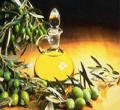
| Olive oil is almost unique among oils in that it can be consumed
in the crude form without refining. This has the effect of conserving all
its vitamins, essential fatty acids, and other nutrients. Because it
contains all these nutrients, including powerful antioxidants, real extra
virgin olive oil is beneficial to health and protects us from damage by free
radical oxidation. Cell membranes contain fatty acids that are highly
susceptible to free radical damage. This damage produces lipid peroxides
that can kill the cell. Real olive oil contains polyphenols, vitamin E, and
other natural antioxidants (vitamin
A) that prevent this damage. These same antioxidants also add
to the stability, shelf life, and flavor of the oil.
It is monounsaturated,
therefore it lowers the “bad” LDL cholesterol without reducing the “good”
HDL cholesterol. This results in improved circulation, lowered blood
pressure and less risk for heart disease. Recent research also indicates
that olive oil may be especially effective in preventing both breast cancer
and osteoporosis. Its high concentration of oleic acid not only keeps our arteries supple, it is also partly responsible for olive oil’s popularity--it is a fairly stable oil with a high smoking point. This means it is suitable for all cooking except frying, and it stores for a year to a year and a half in cool, dark storage conditions. Historically, high quality olive oil, rich in antioxidants, was easy to obtain, but not any more. Today, high quality oil is available only in relatively small quantities, usually from family owned farms, where the oils are produced in ways similar to how the Greeks and Romans made theirs. On these farms, olives are picked by hand so as not to damage the skin or pulp. They are transported in well aerated containers and milled within 48 hours of harvesting. Before milling, leaves and twigs are removed, the olives washed and dried, and then stone pressed the same way as it was done in antiquity. The resulting olive paste was then pressed in a hydraulic press without the use of heat, hot water, or solvents. The oil is left unfiltered as filtering removes many nutrients. The first pressing produces the best "extra virgin" oil. The problem with most of today's olive oil is that it is rarely produced in the old way, which is more time consuming and expensive. Due to the increasing demand for olive oil, the trend has been to reduce production costs by moving toward more automation and concentration of production in ever larger installations. These modem factories extract more oil more cheaply, but their processing methods substantially reduce the nutritional quality of the oil. To reduce costs, olives are machine harvested along with leaves and twigs. Olives that have dropped on the ground, which can be said to contain bad oil, are often mixed with the good ones. They are shipped in all kinds of containers, many of which are poorly ventilated, and heaped in large piles where the olives are stored for too long and often become moldy. The oil is then extracted in a continuous centrifuge where hot water is used to help separate out the oil. Antioxidant polyphenols are soluble in water and are washed away in this process, thereby lowering the shelf life and the nutritional quality of the oil. Italy alone produces 800,000 cubic meters of waste water per year from this process. Because substantial amounts of antioxidants are washed away, factory produced olive oils have a short shelf life of only months, whereas real olive oil lasts for two to three years. Factory produced olive oil is filtered and looks clear. Real olive oil is not filtered and looks cloudy. Most people think that by purchasing "extra virgin" olive oil they are getting a high quality oil. Unfortunately, in most cases, this is not true. It's more complex than that. A label reading extra virgin is no guarantee of quality. For one thing, nowhere does it say that extra virgin olive oil has to be made 100% from olives. An major criterion for grading olive oil is its level of acidity. Extra virgin oil should have a free oleic acid acidity of no more than one percent, whereas ordinary virgin olive oil can have an acidity of up to 3.3 percent. Lower quality oils can be refined to bring the acidity down so they can be labeled as extra virgin. But now the oil has been refined, and that's not what you want. That's why being labeled extra virgin is no guarantee of getting high quality oil, which has not been processed in ways that reduce its nutritional value. How does one ensure that they are eating the most healthful oil? Find an extra virgin olive oil that is cold pressed, unfiltered, and looks cloudy. The oil should be packaged in dark glass bottles to protect it from the damaging effects of light. Real olive oil is still made in small estate bottled settings. The challenge is to find one that does it! all right. After selecting the oil, it has to be stored properly. When properly stored, real extra virgin olive oil can last two to three years. Because of processing, most of the extra virgin oil on the market has a shelf life of only a few months. A good rule of thumb is to purchase oil in small bottles and consume it within a year of purchase; this will also ensure getting the best flavor. Store the oil away from both heat and light. Storing in a dark place is important because exposure to light will start a chain reaction that will destroy the oil a thousand times faster than oxygen. During storage, olive oil oxidizes and undergoes a slow, continuous, and irreversible deterioration until it becomes inedible. |